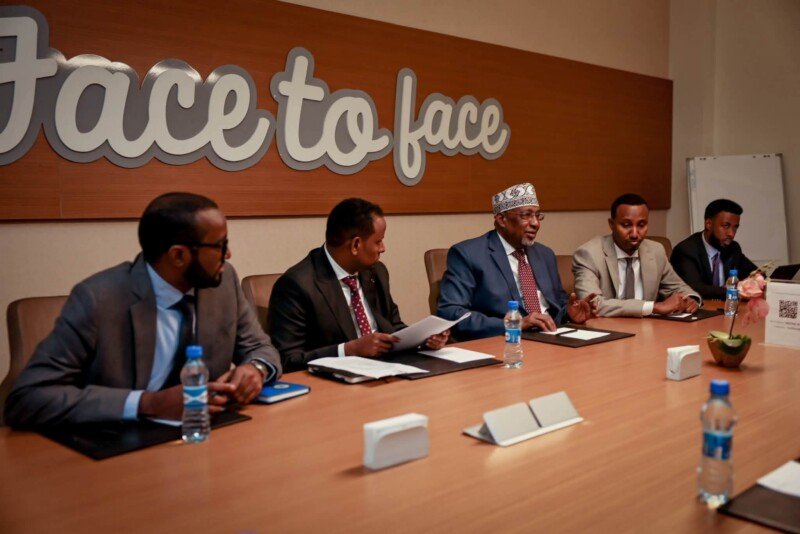
MOGADISHU — The leader of the South West State of Somalia, Sheikh Aden Mohamed Nur (Madobe), has held a meeting in Mogadishu with the Head of the European Union Capacity Building Mission in Somalia (EUCAP Somalia), Kęstutis Lančinskas, to discuss strengthening cooperation on security, institutional capacity-building, and development.
Sheikh Aden Madobe, who was elected President of the South West State in July 2026 after serving as Speaker of the House of the People since April 2022, is in Mogadishu for a working visit. His transition from Speaker to regional president was itself a subject of political discussion, with critics questioning the concentration of power and the erosion of legislative independence.
Madobe’s election as South West State President drew controversy, with Sharif Hassan withdrawing from the race citing irregularities in the electoral process. The election took place in Baidoa, the interim capital of the South West State, with Madobe securing the majority of votes from the regional parliament.
The meeting with EUCAP Somalia focused on enhancing security cooperation, strengthening the capacity of security institutions, and supporting stability and development efforts in South West State. Madobe expressed gratitude for the European Union’s continued support to Somalia, emphasising the importance of deepening collaboration in security, development, and social services.
The EU is set to deploy a military mission to Somalia in 2026, as part of broader efforts to enhance maritime security and support Somalia’s security sector development. The meeting between Madobe and EUCAP Somalia reflects ongoing engagement between regional authorities and international partners on security and governance.
EUCAP Somalia’s Role in Security Sector Development
EUCAP Somalia is a civilian, non-executive mission established to strengthen Somali capacity to provide maritime security and rule of law, contributing to the stability and development of Somalia. The mission provides strategic advice, training, and mentoring to Somali authorities on maritime governance, policing, and justice sector reform.
Madobe’s meeting with EUCAP Somalia reflects his administration’s focus on improving security and governance in South West State, a region that has experienced ongoing conflict with Al-Shabaab and faces significant development challenges.
South West State, which includes the Bay, Bakool, and Lower Shabelle regions, is one of Somalia’s most strategically important federal member states. The region has been the site of significant military operations against Al-Shabaab, with Somali forces and international partners working to secure key areas and protect civilians.
Madobe has chaired high-level security meetings in Baidoa, aimed at consolidating authority and addressing persistent security challenges in one of Somalia’s most volatile federal member states.
Madobe’s Transition from Speaker to Regional President
Sheikh Aden Madobe has had a long and influential political career. He was first elected Speaker of the Transitional Federal Parliament in January 2007 and briefly served as acting President of Somalia from December 2008 to January 2009. He was re-elected as Speaker of the House of the People in April 2022, serving until his election as South West State President in July 2026.
His transition from Speaker to regional president was a subject of political debate, with some critics viewing it as a consolidation of power that undermined the independence of the legislature. However, Madobe’s supporters have argued that his experience and leadership would be valuable in addressing the security and development challenges facing South West State.
President Hassan Sheikh Mohamud praised Madobe ahead of his transition to the South West role, though critics questioned the concentration of power and the erosion of legislative independence.
Critical Note
While the meeting between Sheikh Aden Madobe and EUCAP Somalia reflects ongoing efforts to strengthen security and development cooperation, the effectiveness of these partnerships will ultimately depend on implementation and accountability. South West State continues to face significant challenges, including Al-Shabaab’s persistent presence in rural areas, limited institutional capacity, and governance deficits. The EU’s support, while valuable, must be accompanied by reforms that ensure resources are used effectively and that security institutions operate within a framework of rule of law and civilian oversight.
Furthermore, Madobe’s tenure as South West State leader has been marred by controversy. Local residents and elders have criticized his administration, alleging it was installed with federal backing rather than through broad local consensus. They have also accused the authorities of unfair power-sharing and unequal distribution of government positions, claims they say have fueled grievances among several clans. The city of Baidoa has experienced recurring violence, with forces loyal to the former president, Abdiaziz Hassan Mohamed (Laftagareen), launching multiple attacks in and around the city, turning it into an active zone of contest between rival political and military blocs. The fighting has deepened fears among the civilian population and has compounded an already severe humanitarian crisis, with parts of South West State, including the Buurahakaba area, showing near-famine signs due to prolonged drought and continued conflict.
The government would be well advised to ensure that regional leadership transitions are conducted transparently and that the independence of federal institutions is respected. The international community, while supporting development and security cooperation, must also press for accountability, good governance, and inclusive political settlements that address the grievances of all communities in South West State.