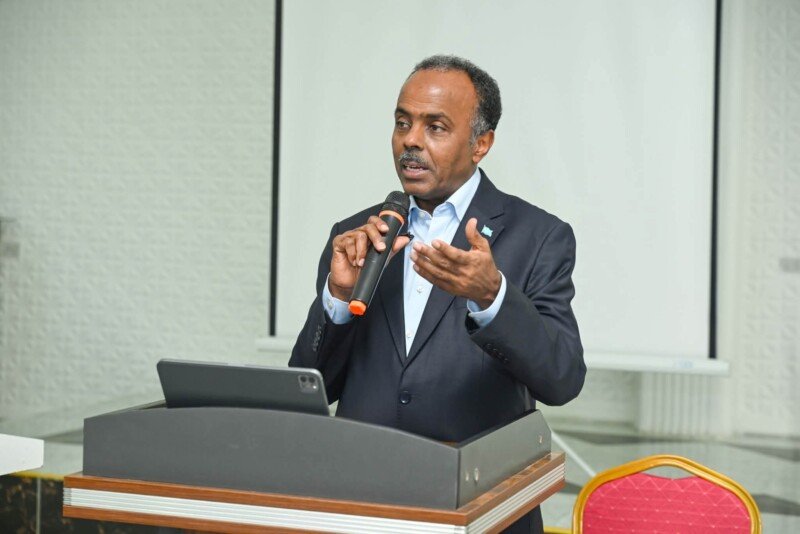
MOGADISHU – State Minister for Foreign Affairs and International Cooperation, Ali Mohamed Omar (Balcad), has delivered a lecture on Somalia’s diplomatic achievements over the past four years, presenting a narrative of renewed international engagement that sits uncomfortably alongside persistent failures in transparency, accountability, and strategic judgment.
The address, organized by the Ministry’s Diplomatic Studies Institute, was attended by ministry staff, federal government officials, and university students. Minister Balcad highlighted progress in strengthening bilateral relations, advancing economic diplomacy, and safeguarding Somalia’s sovereignty. Yet the lecture, while comprehensive, omitted critical details about the minister’s own controversial track record and the opaque nature of some of the very agreements he celebrated.
A Diplomat with a Controversial Past
Minister Balcad’s tenure has been marked by a series of diplomatic missteps that have raised questions about his judgment and effectiveness. In September 2025, he met with U.S. Senator Ted Cruz, a vocal advocate for U.S. recognition of Somaliland, without securing any commitment from the senator to drop his advocacy. The meeting was widely criticized as a diplomatic blunder that gave legitimacy to a figure actively working to undermine Somalia’s territorial integrity.
More recently, Balcad has faced scrutiny for his public statements on Turkey’s role in Somalia. In a September 2025 opinion piece, he wrote extensively about Turkey’s contributions to Somalia’s recovery, but critics noted that his effusive commentary appeared to overlook the growing concerns among Somali legislators about the lack of transparency surrounding bilateral agreements with Turkey, including a secret oil and gas deal that grants Ankara exclusive control over exploration and marketing, with Somalia receiving just 5% in royalties.
Balcad has also been criticized for his handling of a U.S. Congressional report that reaffirmed Somalia’s sovereignty while outlining enhanced security and trade engagement with Somaliland. In response to the report’s release, Balcad took to social media to defend Somalia’s position, but his tweets were quickly deleted, a move that drew sharp criticism from Somali observers who accused him of failing to adequately defend the country’s interests.
The Turkey Deal: A Pattern of Secrecy
The contrast between Turkey’s parliamentary transparency and Somalia’s secrecy could not be more pronounced. While the Turkish parliament debated and approved the two-year extension of its military mission in Somalia openly, Somali legislators have been systematically excluded from reviewing major agreements with Turkey. Somali Senator Professor Abdi Ismail Samatar has publicly accused Ankara of operating on the basis of “fraudulent” agreements that the Somali Parliament has never seen.
A leaked oil and gas deal between Somalia and Turkey, reportedly signed in secret by only two Somali ministries, grants Turkey exclusive control over exploration, refining and marketing operations, with Somalia entitled to just 5% in royalties. The agreement was never disclosed to the Somali Parliament, a clear violation of the country’s constitutional order. Member of Parliament Abdirahman Abdishakur Warsame has described the deal as “deeply imbalanced,” warning that it could compromise Somalia’s national interests.
A Diverse Portfolio of Bilateral Partnerships and Unanswered Questions
The Ministry’s diplomatic engagement has expanded across multiple regions. In June 2026, Foreign Minister Abdisalam Abdi Ali attended the Korea-Africa Ministerial Meeting in Seoul. Somalia has pursued enhanced relations with Sudan, renewed defence ties with Turkey, and signed a landmark fisheries agreement with China granting tariff-free access to the Chinese market.
Yet each of these achievements raises questions about the terms of engagement. China’s zero-tariff policy, while welcome, comes with its own geopolitical calculations. Saudi Arabia and Qatar have deepened their security cooperation with Somalia, but the details of these agreements remain shrouded in secrecy. The government’s failure to ensure parliamentary oversight and public transparency in its international agreements has raised concerns about whether these diplomatic initiatives will genuinely benefit the Somali people or primarily serve the interests of political elites.
Safeguarding Sovereignty Or Failing to Do So?
A central pillar of Somalia’s foreign policy has been the defense of its sovereignty and territorial integrity. The Ministry has consistently opposed any recognition of Somaliland, and the Arab League and IGAD have joined the GCC in rejecting any unilateral recognition of the breakaway region.
Yet despite these diplomatic efforts, Somaliland has continued to gain international traction. Israel recognized Somaliland in December 2025, and the U.S. Congressional report outlined enhanced engagement with the region. Somalia’s diplomatic response has been reactive rather than proactive, and the government’s failure to present a coherent strategy for countering Somaliland’s diplomatic advances has left it constantly on the back foot.
A Mixed Record of Achievement and Unfulfilled Promise
While the Ministry’s diplomatic engagement has been extensive, the gap between diplomatic ambition and tangible results remains wide. Somalia’s foreign policy has succeeded in securing high-level meetings, signing agreements, and building partnerships, but translating these into meaningful improvements in the lives of ordinary Somalis has proven elusive. The country continues to face significant challenges, including persistent threats to its territorial integrity, economic vulnerability, and the ongoing security crisis posed by Al-Shabaab.
The diplomatic achievements highlighted by Minister Balcad are real, but they must be measured against the backdrop of Somalia’s broader struggles. The government’s failure to ensure parliamentary oversight and public transparency in its international agreements has raised questions about whether these diplomatic initiatives will genuinely benefit the Somali people or primarily serve the interests of political elites.
Way Forward
Minister Balcad’s lecture on Somalia’s diplomatic landscape reflects the government’s efforts to rebuild the country’s international standing and expand its global partnerships. However, the minister’s own controversial track record, the lack of transparency surrounding key agreements, and the gap between diplomatic rhetoric and tangible results raise serious questions about the effectiveness of Somalia’s foreign policy.
If Somalia is to build a credible and effective diplomatic service, it must move beyond high-level meetings and photo opportunities. It must ensure transparency and accountability in its international engagements, strengthen parliamentary oversight, and address the underlying challenges of security, governance, and economic development that continue to undermine the country’s stability. Until then, the Ministry’s achievements will remain a foundation that has not yet been built upon a promise that has not yet been fulfilled.
Recommended Reading On ftlsomalia.com
- Somalia Deputy Foreign Minister Meets Turkish Counterpart Amid Controversial Past
- Turkish Parliament Approves Two-Year Extension of Military Mission in Somalia
- State Minister Ali Balad Rejects ICG Report on Al-Shabaab Gains, Defends Government’s Progress
- Somalia Pursues Enhanced Relations with South Korea at Korea-Africa Ministerial Meeting
- Somali Foreign Minister and Saudi Counterpart Discuss Bilateral Cooperation
- Somalia and China Establish Diplomatic Research Center for Strategic Cooperation