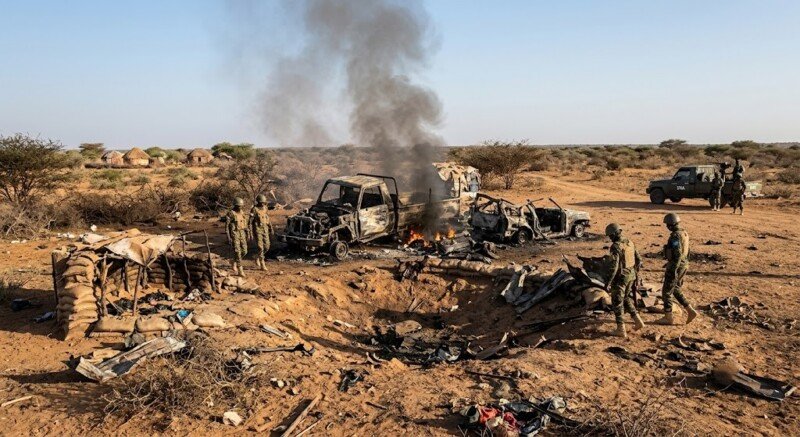
MOGADISHU – Clan fighting in the Dawaco area of Badhan district in the Sanaag region has left an unknown number of people dead and wounded, the latest eruption of violence in a territory where overlapping claims by Somaliland, Puntland and the federal government have created a governance vacuum that continues to claim lives. The Federal Government has responded with ministerial statements, but concrete action to address the underlying causes remains absent.
The clashes, which broke out Saturday morning, followed fierce fighting between the same two clans in the Lasimo area in May that left more than 20 people dead. Reports from the area indicate gunfire lasted for nearly three hours and the situation remains tense.
A Contest of Claims, Not a Single Dispute
The Sanaag region is not merely “disputed territory” in a simple binary sense. It is a space where three competing claims intersect:
– Somaliland claims the region as part of its self-declared territory and has repeatedly denounced federal efforts to establish alternative administrations there.
– Puntland claims jurisdiction over parts of Sool and Sanaag, and has resisted federal attempts to formalise SSC-Khaatumo as a separate federal member state.
– The Federal Government has recognised the North Eastern State (formerly SSC-Khaatumo) as a federal member state, with its capital in Las Anod, encompassing parts of the Sool, Sanaag and Togdheer regions.
The violence in Dhahar in July 2025, which left several dead and wounded, was directly linked to the federal government’s push to formalise SSC-Khaatumo as a regional state headquartered in Las Anod. This initiative has drawn fierce opposition from Puntland and Somaliland, both of which claim jurisdiction over parts of Sool and Sanaag. The rising death toll in Dhahar has underscored the volatility of the federal government’s regional agenda. The Federal Government has expressed regret over the deadly Dhahar incident and called for restraint from all parties.
A Familiar Pattern of Violence
The fighting follows fierce clashes between the same two clans in the Lasimo area in May, which left more than 20 people dead. In May 2026, deadly clashes erupted in the Carma area near Erigavo, leaving at least 40 people dead in one of the most serious outbreaks of violence witnessed in the region in recent years. At least 17 people were killed in inter-clan clashes at Dararweyne village in El-Afweyne district of Sanaag. The Sool-Sanaag dispute involves local, regional and national dynamics, and clan conflicts are expected to persist into 2025, driven by unresolved land disputes, political rivalries, and climate-induced resource scarcity.
The pattern is painfully predictable. Drought dries up water sources and grazing land. Pastoralist communities, already marginalised and neglected by successive governments, compete for dwindling resources. Violence erupts. Elders and officials issue calls for calm. And the cycle repeats, as it has for decades, with little evidence of a sustained break.
Statements, Not Solutions
Commerce Minister Jamaal Mohamed Hassan, who hails from the region, described the renewed fighting as a “great misfortune” and urged both sides to cease hostilities unconditionally. He also appealed to the North Eastern State administration, religious scholars, women, elders, youth and other segments of society to urgently intervene.
The Ministry of Interior, Federal Affairs and Reconciliation of the North Eastern State also called for an immediate end to the renewed violence. “We urge the parties involved in the conflict to unconditionally cease fighting and maintain peace, harmony and the safety of civilians,” the statement said.
Yet the North Eastern State’s capacity to enforce peace is limited. The administration, which was established in 2025 replacing the interim SSC-Khaatumo administration, remains fragile and its authority in areas like Badhan is contested. The region is claimed by both Somaliland and Puntland, with overlapping clan affiliations and historical claims complicating any effort at governance.
A Governance Vacuum With Deadly Consequences
The Sanaag conflict cannot be understood in isolation from the broader struggle for control of the region. The territorial dispute between Somaliland and SSC-Khaatumo forces has highlighted the ongoing tensions in the region, with the Sool, Sanaag, and Cayn regions remaining points of contention due to overlapping clan affiliations and historical claims. Renewed clashes between Somaliland and SSC-Khaatumo forces have been reported in Buqdharkayn, underscoring the fragility of the situation and the potential for further escalation.
The federal government’s response to the current fighting has been limited to ministerial statements, with no indication of concrete action to address the underlying causes of the conflict. Somaliland has slammed Mogadishu over the creation of the “North-Eastern State,” warning of a civil war risk and describing the move as a “reckless provocation” that “violates the will of the people of Somaliland, disregards historical realities, and escalates an already volatile situation”. Somaliland President Abdirahman Abdillahi Irro has expressed support for Puntland leader Said Deni’s peace proposal aimed at resolving the Sanaag conflict, but the success of such initiatives will depend on sustained commitment from all parties.
Way Forward
The renewed fighting in Sanaag is a stark reminder of the fragility of peace in Somalia’s northeastern regions. The federal government’s statement, while welcome, is insufficient. Without sustained investment in conflict resolution mechanisms, without addressing the underlying competition for resources exacerbated by climate change, and without a genuine effort to establish effective governance in disputed areas, the cycle of violence will continue.
The North Eastern State’s reliance on community leaders to take the lead in peacemaking is a recognition of its own institutional weakness. But elders and traditional leaders cannot do it alone. The federal government, the North Eastern State, and the international community must move beyond statements and take concrete action to address the root causes of the conflict. Until then, the people of Sanaag will continue to pay the price.
Recommended Reading On ftlsomalia.com
- Somaliland President Welcomes Peace Proposal from Puntland Leader for Solving Sanaag Conflict
- Rising Death Toll in Dhahar as Federal Push for SSC-Khaatumo Sparks Armed Clashes
- Renewed Clashes between Somaliland and SSC Khatumi Troops Reported in Buqdharkayn
- Somaliland Slams Mogadishu Over “North-Eastern State,” Warns of Civil War Risk
- Somali Government Regrets Deadly Dhahar Incident