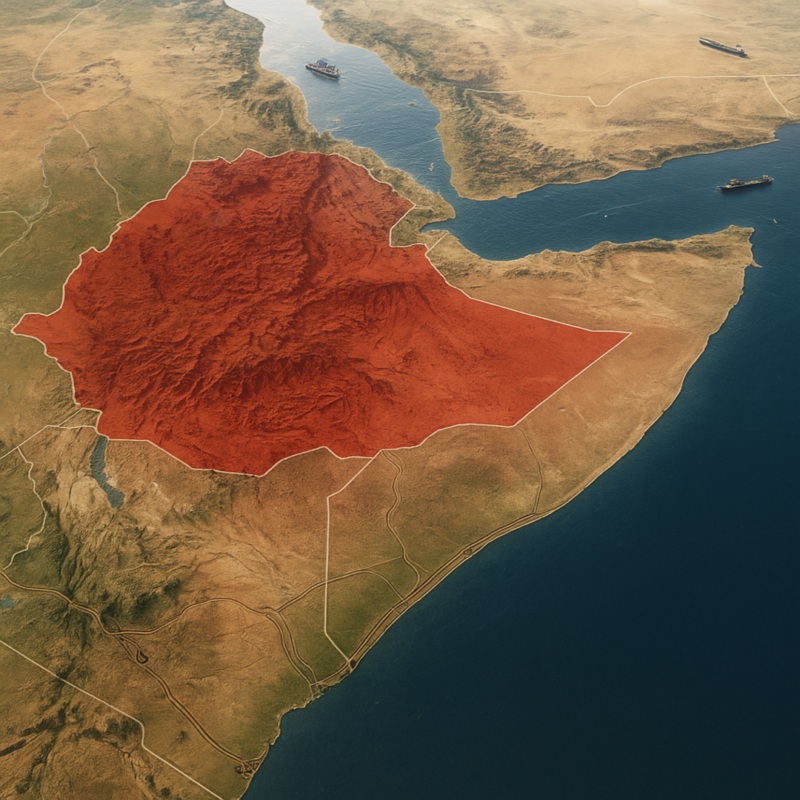
ADDIS ABABA — Ethiopian Prime Minister Abiy Ahmed has stated that durable peace in the Horn of Africa cannot be achieved as long as Ethiopia remains without direct coastline access, renewing his country’s long-standing strategic ambition to secure a maritime outlet.
In an interview with Ethiopian National Television, Abiy contended that the absence of direct port access restricts Ethiopia’s economic expansion and international competitiveness. He characterized maritime access as vital for the nation’s sustained advancement and self-reliance.
“The main factor preventing Ethiopia from becoming self-sufficient and competing in the global economy is the absence of ports,” the prime minister said.
Impact of Global Conflicts on Maritime Access
The Prime Minister also emphasized the effects of global conflicts, specifically disruptions in vital sea passages like the Strait of Hormuz, cautioning that such occurrences have significant repercussions for nations reliant on foreign harbors. He encouraged Ethiopians to decrease fuel usage while the administration develops permanent resolutions.
Abiy mentioned that Ethiopia is committing to infrastructure development, including rail networks, roadways, and logistical frameworks, to diminish dependence on adjoining ports. However, he underscored that a durable resolution would necessitate Ethiopia obtaining direct sea access via discussions and regional partnership.
Ethiopia’s Landlocked Status and Regional Tensions
The comments surface as Ethiopia continues exploring alternatives for port accessibility, an initiative that has attracted regional notice due to its possible geopolitical ramifications. With a population exceeding 120 million, Ethiopia is the world’s most populous landlocked country. It lost its access to the sea when Eritrea seceded in 1993.
Since then, Ethiopia has been forced to rely on Djibouti’s ports for over 95 percent of its imports and exports, subjecting Addis Ababa to fluctuating tariffs, local instability, and significant economic costs. World Bank reports estimate that transit fees and logistics cost the Ethiopian economy billions of dollars annually.
The Ethiopia-Somaliland Memorandum of Understanding
In January 2024, Ethiopia signed a Memorandum of Understanding with the breakaway region of Somaliland, granting Addis Ababa access to a 20-kilometer coastal strip at the port of Berbera on the Red Sea for 50 years, in exchange for recognition of Somaliland as an independent state.
Somalia swiftly and forcefully rejected the agreement. President Hassan Sheikh Mohamud described the move as a “blatant violation” of Somali sovereignty, asserting that “no one can take a single inch of Somalia.”
“This is not a port deal,” one Somali diplomat said privately. “This is a question of our existence as a nation.”
Federal Government’s Firm Stance
The Federal Government of Somalia has consistently opposed any unilateral actions compromising its territorial integrity. Somalia denied Ethiopia’s request for direct access to the port, with State Minister for Foreign Affairs Ali Omar stating that “our territorial integrity and sovereignty remain sacrosanct, enshrined in the constitution, and not the subject of any discussion”.
President Mohamud has accused Ethiopia of trying to annex Somali territory through the Somaliland sea deal. “The agreement between Ethiopia and Somaliland is nothing more than annexing part of Somalia to Ethiopia, and changing the borders of Somalia,” Mohamud told reporters. “Somalia categorically objects to that.”
Ankara Agreement and Diplomatic Breakthrough
Following Turkish-mediated talks in December 2025, Somalia and Ethiopia reached a breakthrough agreement known as the Ankara Declaration. The two leaders “reaffirmed their respect and commitment to one another’s sovereignty, unity, independence and territorial integrity.”
The statement emphasized that further talks on Ethiopia’s sea access would not compromise Somalia’s sovereignty. Turkish President Recep Tayyip Erdogan, who mediated the talks, said he believed the agreement would ensure Ethiopia’s long-desired access to the sea through commercial arrangements such as leases and contracts.
Alternative Proposals and Regional Dynamics
Djibouti has offered a compromise solution that would give Ethiopia access to the port of Tadjoura, about 100 kilometers from the Ethiopian border, as well as a new corridor to the northern border of Djibouti. This proposal is seen by analysts as a credible attempt to ease tensions and could pave the way for a face-saving compromise.
The dispute has drawn in external powers, with Egypt signing a defense cooperation agreement with Somalia that has seen weaponry transported from Cairo to Mogadishu. This move has prompted a furious reaction from Abiy’s government, which warned that “Ethiopia cannot stand idle while other actors are taking measures to destabilize the region.”
Legal Framework and Regional Stability
The 1982 United Nations Convention on the Law of the Sea, specifically Article 125, stipulates the right of landlocked states to access the sea through safe and effective corridors, provided this is done through agreement with the states concerned and in full respect of their sovereignty. International law experts note that the text grants a “right of transit passage,” not a “right of ownership or sovereignty.”
Abiy Ahmed’s declaration reaffirms Ethiopia’s persistent strategic aim of securing oceanic passage, presenting it as both an economic essential and a regional stability matter. While framed as a collaborative objective, the topic is particularly delicate in the Horn of Africa, where harbor accessibility intersects with sovereignty and territorial issues.
Pursuing this aim through diplomatic dialogue will be crucial to preventing increased tensions in an already volatile area. The future of the region appears contingent on the ability of its states to craft collective arrangements that balance transit rights with respect for sovereignty — and prevent geography from becoming the spark of a new conflict.