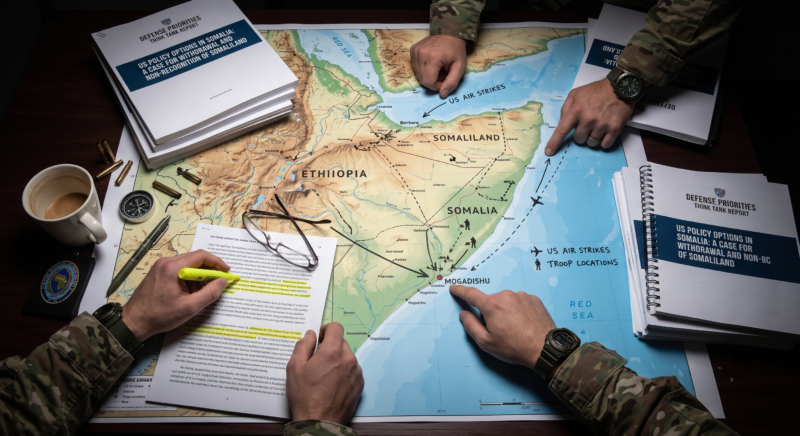
WASHINGTON – A new report from the Defense Priorities think tank urges the Trump administration to reject recognizing Somaliland and withdraw all U.S. troops from Somalia, arguing that the two-decade counterterrorism war has failed to advance American interests and has instead strengthened the very insurgent groups it was meant to defeat.
The report, authored by William Walldorf, a senior fellow at Defense Priorities, warns that deepening U.S. involvement in Somalia’s civil war, including the potential recognition of Somaliland, risks pulling the United States into a costly and unnecessary quagmire.
A War That Hasn’t Worked
The report challenges the official rationale for continued U.S. military engagement, arguing that neither Al-Shabaab nor ISIS-Somalia pose a credible threat to the U.S. homeland. Both groups, it says, are “local insurgencies” focused on domestic political ends rather than global jihad.
The report notes that since February 2025, President Trump has launched nearly four times the number of airstrikes against Somalia’s two main terrorist groups than the Biden administration did in its entire four-year term. Despite this escalation, the groups persist largely unencumbered.
“Force hasn’t worked to curb either group,” Walldorf writes, citing the Congressional Research Service, which concluded that “after over 15 years of counterinsurgency operations, airstrikes have eliminated some ‘high-value’ targets and supported partner operations, but al-Shabaab maintains the capacity to conduct complex, asymmetric attacks.”
The Case Against Somaliland Recognition
The report is unequivocal in its assessment of Somaliland recognition. “The United States gains little or nothing from recognizing Somaliland, which would deepen the chaos in Somalia and threaten to pull the U.S. in further,” Walldorf writes.
The report warns that recognition would fuel al-Shabaab recruitment by giving the group a nationalist narrative to exploit. It cites the 2024 Ethiopia-Somaliland Memorandum of Understanding, which President Hassan Sheikh Mohamud signed a law nullifying, declaring it illegal. The MoU, signed on January 1, 2024, granted Ethiopia access to the Red Sea via Somaliland’s Berbera port in exchange for potential recognition of Somaliland’s independence. The deal sparked a diplomatic row with Somalia and was rejected by an Arab Ministerial Working Group as a violation of Somalia’s sovereignty.
Ethiopia has signalled it may follow the U.S. in recognizing Somaliland, with a senior advisor to Prime Minister Abiy Ahmed suggesting that Addis Ababa is carefully positioning itself to move ahead. Ethiopia and Somaliland have since engaged in discussions to enhance trade and economic cooperation, with a continued commitment to strengthen their economic ties despite the Ankara Declaration signed with Somalia in December 2024.
The report argues that U.S. recognition would have similar recruitment benefits for al-Shabaab and could fuel other semi-independent regions, such as Puntland and Jubaland, to move toward independence, further weakening Somalia and strengthening the insurgency.
The report also argues that new U.S. military bases in Somaliland would be strategically unnecessary. “America does not need bases in Somaliland to check the Houthis in Yemen, who are contained,” it states. The Houthi threat to Red Sea shipping, the report notes, has largely receded following the ceasefire in Gaza.
The Sunk Cost Trap
The report warns that recognizing Somaliland could trigger a sunk-cost dynamic that would drag the U.S. further into the conflict. Once the U.S. has invested in new bases and formal recognition, it will face pressure to protect those investments, potentially leading to deeper military involvement.
“U.S. troops will be caught in the middle of the political chaos, meaning the United States could get sucked into new nation-building wars in Somaliland and/or Somalia,” the report states.
Policy Recommendations
The report offers three main recommendations:
First, the United States should not recognize Somaliland. Recognition would yield almost no benefits but could come with great costs, including deepening regional instability and fueling al-Shabaab recruitment.
Second, the U.S. should withdraw ground forces from Somalia and wind down the air war. Given that neither ISIS-Somalia nor al-Shabaab are global reach terrorist groups, the war is a waste of U.S. resources. The report suggests a phased withdrawal coordinated over several months, handing responsibility over to the government in Mogadishu and the UN-authorized African Union Stabilization and Support Mission in Somalia (AUSSOM).
Third, the White House should take back control of strike authorization from AFRICOM to ensure selectivity and prevent mission creep. Presidential oversight offers the best chance of staying focused on the national interest.
A Note on Threat Inflation
The report is highly critical of what it describes as “threat inflation” by U.S. AFRICOM. It notes that every AFRICOM press release on airstrikes against ISIS-Somalia since January 2025 has included language about stopping threats to the U.S. homeland, whereas only one press release included that language in 2024.
The report cites former Secretary of Defense Mark Esper, who wrote that AFRICOM would “stretch the risk assessment to justify their demands” for resources. “Following Esper’s logic, AFRICOM may view threat inflation as its best chance to prevent Trump from picking up where he left off in 2020, trying to cut the U.S. military presence in Africa,” the report states.
Way Forward
The Defense Priorities report concludes that Somalia is not in the U.S. national interest and that the war is not working. “By escalating in Somalia, the U.S. risks falling victim to a sunk-cost fallacy whereby it justifies future action through its past investment,” Walldorf writes. “Instead, the U.S. should acknowledge it has few interests at stake in Somalia, end direct U.S. military involvement there, step back from recognizing Somaliland, and opt against any new bases or troops in East Africa.”
Recommended Reading On ftlsomalia.com
- Somali President Signs Law Nullifying Somaliland’s MoU with Ethiopia
- Ethiopia’s Ambassador to Somalia Says MoU with Somaliland Benefits Everyone
- Ethiopia Edges Closer to Somaliland Recognition, Signals Strategic Shift
- Ethiopia Requests IGAD for an Extraordinary Meeting to Discuss Row with Somalia
- Arab Ministerial Working Group Meeting in Cairo Rejects Ethiopia’s MoU with Somaliland
- Somaliland Pursuing Increased Trade and Economic Cooperation with Ethiopia