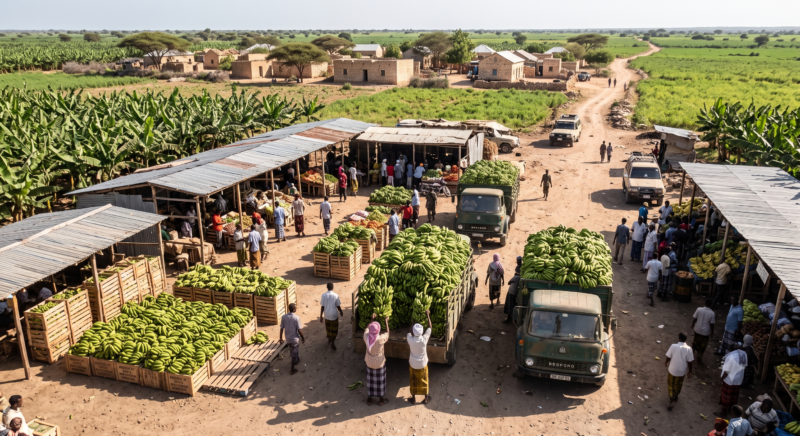
MOGADISHU – Kenyan bananas are reaching Mogadishu markets by sea without facing the checkpoints, government extortion, or import taxes that continue to suffocate Somali farmers in the country’s historic banana heartlands of Janaale and Buulo-Mareer. The disparity has exposed a fundamental failure of Somali trade policy that analysts say is systematically undermining local agriculture while rewarding foreign competitors.
Muhsen Hirabe, a prominent Somali analyst, highlighted the paradox in a recent social media post, noting that Kenyan banana farmers now find it “much easier and more profitable” to supply Mogadishu than local Somali farmers. “I applaud the entrepreneurs who recognized this opportunity and filled the gap. I also ‘thank’ the Somali government for their selfless act of creating a market for Kenyan farmers in Somalia while their local farmers cannot access that same market,” Hirabe wrote.
The Data Behind the Disparity
Trade data from the World Bank’s COMTRADE database reveals the scale of the imbalance. In 2024, Kenya exported $64,000 worth of bananas to Somalia, amounting to 1,058 kilograms. While this figure may appear modest, it represents a growing trend. Between 2021 and 2022, Kenya’s banana exports to Somalia grew by $531, making it the fastest-growing import market for bananas in Somalia. Overall, Kenya’s banana exports to Somalia reached approximately $1,130 in that period.
The broader context is starker. In 2024, Kenya exported $350,660 worth of edible fruits and nuts to Somalia. Meanwhile, Somalia imported $2.84 million worth of bananas from Ethiopia and Kenya combined, with Ethiopia dominating the market. Yemen also exported $3,990 worth of bananas to Somalia in 2024.
The Extortion Economy
The reason Somali farmers cannot compete is not a lack of productive capacity. Janaale, a district in the Lower Shabelle region, was once the center of a vast banana cultivation area spanning 20,000 hectares during the Italian colonial period. By the early 1990s, Somalia was Africa’s largest banana producer and exporter.
Today, farmers in Janaale face a daily struggle between two opposing authorities. During the day, Al-Shabaab controls the farmlands and demands financial ‘contributions’ in the form of zakawat, a form of extortion tax. Farmers must navigate a complex web of checkpoints, known locally as isbaaro, that constitute an intricate network of sites along routes where “trade meets imposition.” The Somali National Army and AUSSOM recently dismantled an illegal checkpoint on the outskirts of Janaale that had been used to extort money from civilians, impose illegal taxes, and disrupt local trade. In another operation, SNA troops captured the villages of Sabid and Anole in Lower Shabelle, which had long been exploited by Al-Shabaab to extort money from local farmers and pastoralists.
The rising cost of isbaaro is directly reflected in the prices consumers pay for food, with farmers including these extortion costs in their pricing. Al-Shabaab collects millions of dollars annually in extortion and zakat (Islamic tax) in areas where government services are either absent or rejected. The group relies on extortion and illegal taxation to fund its insurgency, collecting an estimated $120 million annually from farmers, traders, and vulnerable rural communities. The group can extort and levy taxes both in areas under their direct control and beyond, depending on the strength of government and security forces. The government has declared that these financial demands constitute illegal extortion and cannot be considered Zakat under any circumstances, stripping any religious legitimacy from the group’s demands.
Government Inaction and Lost Opportunity
The Somali government has acknowledged these challenges but has failed to deliver meaningful change. Elite Danab commandos have conducted operations targeting Al-Shabaab extortion networks in Lower Shabelle’s agricultural corridor, destroying fortified hideouts and illegal tax collection checkpoints that had long hindered local economic activity. However, these operations have not eliminated the extortion economy.
Meanwhile, Kenya and Somalia have been engaged in discussions to conclude a trade agreement aimed at eliminating non-tariff barriers. A trade facilitation agreement is in the offing to address irregular non-tariff barriers that have been impacting their trade relations, including inconsistent levies and shifting policies. The Kenya-Somalia Trade Week 2025 was held in Mogadishu to facilitate smoother trade relations. The Kenya National Chamber of Commerce and Industry and the Somalia Chamber of Commerce signed a memorandum of understanding in January 2025, committing to strengthening trade ties.
The irony is not lost on Somali farmers. While the government negotiates trade agreements to benefit Kenyan exporters, it has done little to dismantle the checkpoints and extortion networks that make it impossible for Somali farmers to access their own markets. Kenyan bananas face “no isbaaro, no extortion by government forces, and no import taxes.” Somali bananas face all three.
A History of Decline
The collapse of Somali banana production and export was not inevitable. The decline was due to improper use of agricultural practices and post-harvesting constraints. A study found that 48.5 percent of farm workers in the region have low knowledge of banana cultivation. The sector has also been devastated by conflict, with banana plantations burned during clan clashes over agricultural land in the Janaale area. Tensions are mounting in the Lower Shabelle region amid escalating clan disputes over administrative control, farmland, and governance of areas vacated by Al-Shabaab.
Somalia’s susceptibility to changing regional policies has also contributed to political instability and created fertile ground for Al-Shabaab to thrive. The Institute for Security Studies warns that political infighting, delayed elections, weak federal-state cooperation, and clan rivalries have all created a vacuum Al-Shabaab is quick to exploit. The government’s failure to protect farmers and eliminate extortion has not only destroyed livelihoods but also strengthened the insurgency by making it the de facto authority in agricultural areas.
Way Forward
The paradox of Kenyan bananas reaching Mogadishu markets more easily than Somali produce is a damning indictment of Somali governance. The government’s inability to secure its own agricultural heartland, eliminate extortion networks, and provide a level playing field for Somali farmers has created a situation where foreign producers are effectively subsidized by Somali dysfunction.
As one analyst noted, Somali consumers are the true payers of these extortions. The rising cost of isbaaro is reflected in the prices they pay for food, burdening the most vulnerable. Until the Somali government dismantles the extortion economy and restores security to agricultural areas, Somali farmers will continue to lose ground to foreign competitors, and the country will remain dependent on imports for food that it could produce itself.
Recommended Reading On ftlsomalia.com
- South Africa Never Imported Poisonous Bananas from Somalia, Government Says
- Elite Commandos Dismantle Terrorist Extortion Network in Lower Shabelle
- SNA and AUSSOM Dismantle Al-Shabaab Checkpoint Near Janaale
- SNA Troops Capture 2 Lower Shabelle Villages in Major Anti-Al-Shabaab Offensive
- Al-Shabaab Exploits Somalia’s Divisions to Fuel Violence, Warns ISS
- Somali Deputy Minister: Militant Extortion Not Recognized as Zakat
- Governance Vacuum Fuels Clan Mobilisation in Lower Shabelle
- A Trade Facilitation Agreement Between Somalia and Kenya is in the Offing