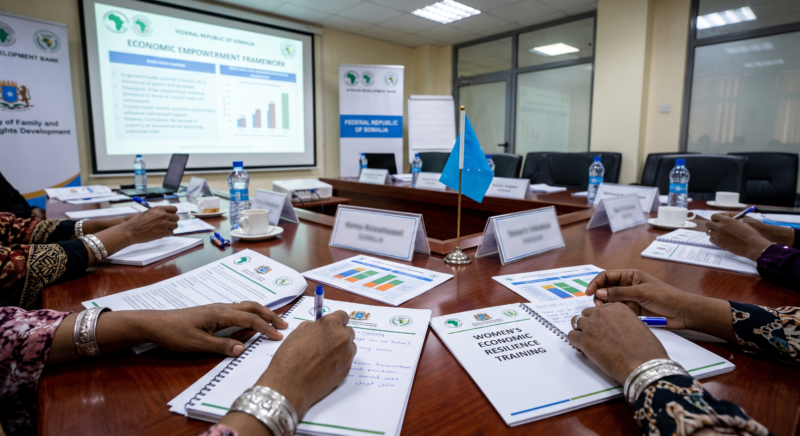
MOGADISHU – Officials from various federal ministries have concluded a training programme in Mogadishu focused on strengthening women’s economic resilience, a project funded by the African Development Bank (AfDB) and implemented in coordination with the Ministry of Family and Human Rights Development and the Intergovernmental Authority on Development (IGAD).
The training, which brought together representatives from multiple government ministries, the IGAD office in Somalia, civil society organisations, women’s groups and traditional elders, focused on enhancing collaboration between state institutions and communities, expanding economic opportunities for women, and accelerating the implementation of plans for sustainable peace and inclusive development.
A Project with Ambiguous Impact
The programme is being rolled out in select federal member states, though specific locations and timelines have not been disclosed. While the initiative is framed as a step toward women’s economic empowerment, the lack of publicly available details about its scope, budget and measurable targets raises questions about its long-term viability.
Somalia has a long history of internationally funded programmes that produce workshops and policy papers but fail to translate into tangible improvements for women. The Ministry of Family and Human Rights Development has previously held high-level meetings with UN Women, renewing commitments to gender equality, but progress on the ground remains slow. The government launched the second phase of a nationwide women’s peace initiative aimed at strengthening women’s participation in peacebuilding and governance, yet implementation has been uneven.
IGAD’s Role and Regional Context
The involvement of IGAD in the project reflects the regional body’s growing focus on gender issues. Sadia Mohamed Nur, a Somali official, was elected to serve as the Director of the IGAD Women, Peace, and Security Forum (IWPSF), with a mandate to advance gender equality and address challenges faced by women in conflict and post-conflict situations. However, the forum’s effectiveness has been limited by funding constraints and the broader instability that continues to plague the region.
AfDB’s Growing Footprint in Somalia
The African Development Bank has been increasing its engagement in Somalia. The bank has funded the ACALS climate resilience project, which provides climate-resilient technologies and livelihood support for pastoralists, farmers, women, and youth, with women and youth identified as key target groups for capacity-building and livelihood support. In May 2026, the AfDB granted Somalia $17.68 million in debt relief following the successful completion of the Enhanced Heavily Indebted Poor Countries Initiative (EHIPC) process. However, the bank’s overall portfolio in Somalia remains modest compared to other donors, and the impact of its investments on the ground is difficult to assess.
A Pattern of Rhetoric Without Results
The training programme is the latest in a series of initiatives aimed at promoting women’s economic empowerment in Somalia. The Ministry of Family and Human Rights Development has convened women’s groups in Baidoa to discuss challenges and opportunities, and the government has launched various programmes to support women’s economic participation. Yet the gap between policy and practice remains wide.
The reality for most Somali women is one of limited economic opportunities, high unemployment and persistent gender-based violence. The government’s commitment to women’s empowerment is often undermined by weak institutional capacity, corruption and the prioritisation of security over social development.
Way Forward
The training programme in Mogadishu is a welcome step, but it is far from sufficient. Without sustained investment, genuine political will and accountability mechanisms, initiatives like this risk becoming another exercise in documentation rather than transformation. For Somali women, the promise of economic empowerment remains distant, and the gap between rhetoric and reality continues to widen. The success of this programme will ultimately be measured not by the number of workshops held, but by the number of women who gain access to meaningful economic opportunities and a voice in the decisions that affect their lives.
Recommended Reading On ftlsomalia.com
- Somalia’s Family Ministry Engages UN Women on Gender Equality Efforts
- Somalia Launches New Women’s Peace Initiative
- Somalia’s Sadia Nur Elected Director of IGAD’s WPSF
- Minister Convenes Women’s Groups in Baidoa to Discuss Challenges and Opportunities
- Somalia’s Livestock Ministry Launches ACALS Climate Resilience Project
- Finance Minister Highlights Reform Progress at AfDB Meetings