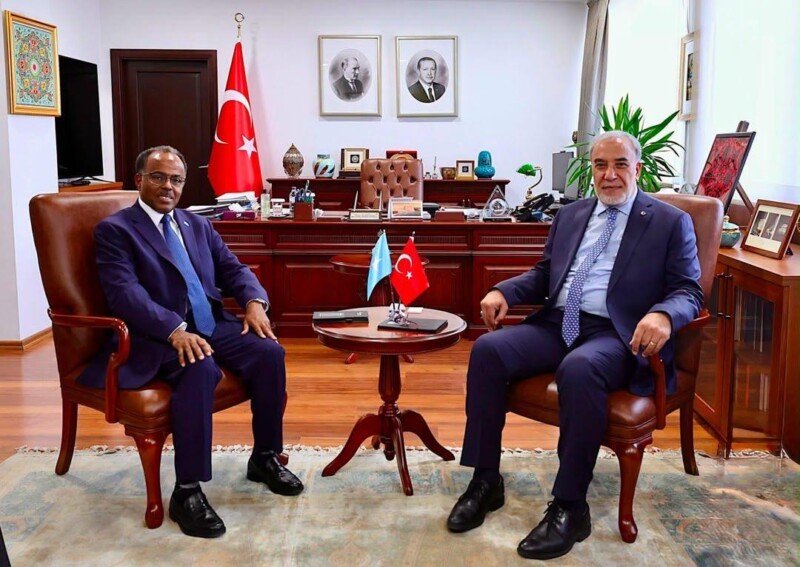
ANKARA – Somalia’s State Minister for Foreign Affairs and International Cooperation, Ali Mohamed Omar, has held talks with Turkish Deputy Foreign Minister Ambassador Musa Kulaklıkaya in Ankara, as the two countries continue to deepen their bilateral ties amid growing Turkish military and economic engagement in the Horn of Africa.
The meeting, which took place on July 21, focused on strengthening bilateral relations and regional developments. According to a statement from the Turkish Foreign Ministry, the two officials discussed ways to enhance cooperation between the two countries, as well as political developments in the Horn of Africa.
A Diplomat with a Controversial Track Record
Ali Omar, who also serves as a Member of Parliament, has been a prominent figure in Somalia’s foreign policy apparatus, but his tenure has been marked by a series of diplomatic missteps that have raised questions about his judgment and effectiveness.
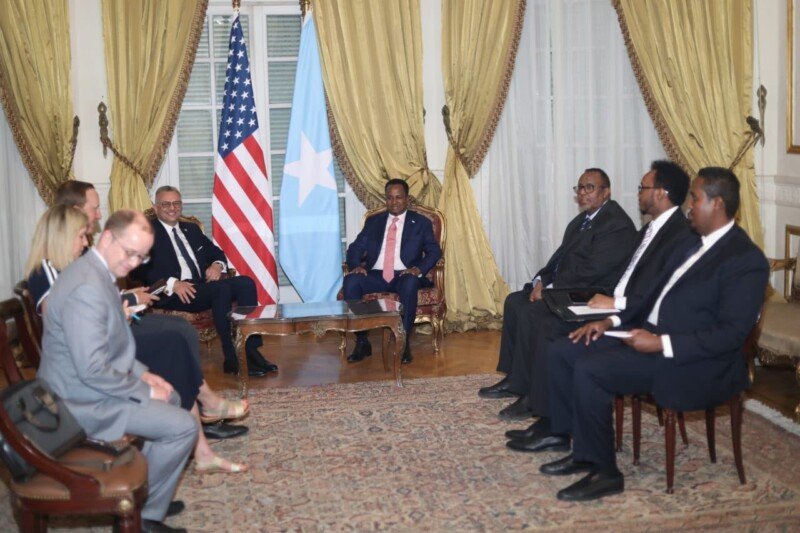
In September 2025, Omar met with U.S. Senator Ted Cruz, a vocal advocate for U.S. recognition of Somaliland. Cruz, who chairs the Senate Foreign Relations Subcommittee on Africa, has been one of the most prominent American lawmakers pushing for Washington to formally recognize the breakaway region. Omar’s decision to engage with Cruz, without securing any commitment from the senator to drop his advocacy for Somaliland, was widely criticized as a diplomatic blunder that gave legitimacy to a figure actively working to undermine Somalia’s territorial integrity. Omar did not confirm whether the issue of Somaliland recognition was raised during the meeting.
More recently, Omar has faced scrutiny for his public statements on Turkey’s role in Somalia. In a September 2025 opinion piece, he wrote extensively about Turkey’s contributions to Somalia’s recovery. While his praise for Ankara may have been diplomatically useful, critics have noted that his effusive commentary appeared to overlook the growing concerns among Somali legislators about the lack of transparency surrounding bilateral agreements with Turkey, including a secret oil and gas deal that grants Ankara exclusive control over exploration and marketing, with Somalia receiving just 5% in royalties.
Deleted Tweets and the U.S. Congressional Report
Omar’s diplomatic record has also been called into question over his handling of a U.S. Congressional report that reaffirmed Washington’s official recognition of Somalia’s sovereignty and territorial integrity while simultaneously outlining multiple avenues for enhanced security, diplomatic, and commercial cooperation with Somaliland. The report, developed under Section 7019(e) of the 2026 National Security, Department of State, and Related Programs Appropriations Act, confirmed that the United States continues to acknowledge Somalia’s sovereignty and territorial integrity while exploring increased engagement with Somaliland authorities.
In response to the report’s release, Omar took to social media to defend Somalia’s position, reaffirming Somalia’s sovereignty and insisting that any international partnership must respect Somalia’s constitutional framework and national unity. However, his tweets were quickly deleted, a move that drew sharp criticism from Somali observers who accused him of failing to adequately defend the country’s interests. Critics argued that Omar’s initial response was weak and that his subsequent deletion of the tweets suggested an unwillingness to engage with the substance of the report or to hold the U.S. accountable for its dual-track approach.
The report’s release also coincided with sharp criticism of President Hassan Sheikh Mohamud from a former U.S. ambassador to Somalia, Larry Andre, who accused Mohamud of deliberately breaking down the nation’s federal system, a move Andre argued has unexpectedly supported Somaliland’s quest for independence. The congressional report underscores Somaliland’s strategic positioning near the Bab al-Mandab Strait and the Red Sea, characterizing it as a potentially valuable partner in addressing common security challenges, including monitoring and countering extremist threats.
Turkey’s Expanding Footprint in Somalia
The meeting in Ankara comes at a time of deepening Turkish engagement in Somalia. The Commander of the Turkish Land Forces, General Metin Tokel, recently arrived in Mogadishu for high-level talks with Somali military officials, underscoring Ankara’s commitment to bolstering the operational readiness of Somali security forces. Somalia and Turkey renewed their defence ties with a revised protocol in July 2025, marking a strategic recalibration of the original agreement and ushering in a new phase of enhanced military cooperation.
In February 2026, a Turkish military transport docked at Mogadishu Port, offloading a shipment of M48 and M60 Patton battle tanks, signaling a major escalation of Ankara’s military footprint in the Horn of Africa. The tanks are expected to be positioned to defend Turkish installations in the Warshiikh district, approximately 60 kilometers north of Mogadishu, where facilities are reportedly being prepared for missile and satellite launch operations.
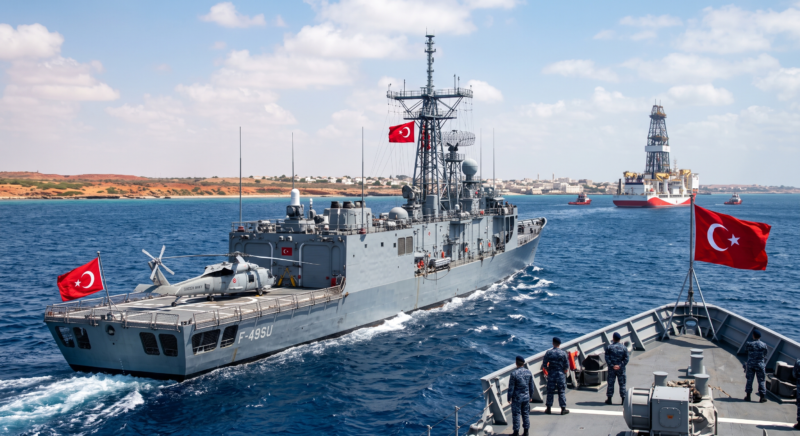
Turkish naval vessels are currently escorting and protecting a drilling fleet operating off the Somali coast, including the Cagri Bey ultra-deep-sea drillship, which began its inaugural international deep-water energy operation in early 2026. Turkish warships have been providing security for the vessel and its crew in the strategic waters off the Horn of Africa. Turkey’s drilling vessel, the Cagri Bey, departed from Mersin Port heading toward the Somali coast to commence its operations, with the mission being safeguarded by the Turkish Naval Forces Command.
A Relationship Built on Unequal Terms
While Turkey has positioned itself as a key partner in Somalia’s security and development, critics have raised concerns about the asymmetry of the relationship. Somali legislators have been systematically excluded from reviewing key agreements with Turkey, including the defence protocol and the oil and gas deal. Somali Senator Professor Abdi Ismail Samatar has publicly accused Ankara of operating on the basis of “fraudulent” agreements that the Somali Parliament has never seen.
Omar’s meeting with Kulaklıkaya, while framed as a step toward strengthening bilateral ties, raises questions about whether Somali officials are adequately representing their country’s interests in negotiations with a much more powerful partner. The gap between Ankara’s strategic ambitions and Mogadishu’s ability to negotiate from a position of strength remains wide, and Omar’s track record, from his meeting with Ted Cruz to his deleted tweets on the U.S. Congressional report, suggests he may not be the most effective advocate for Somali interests.
Way Forward
The meeting between Ali Omar and Musa Kulaklıkaya is a reminder of the deepening but increasingly asymmetrical relationship between Somalia and Turkey. While Ankara has positioned itself as a key partner in Somalia’s security and development, questions remain about the transparency and balance of the agreements governing their relationship.
For Somalia, the challenge is to ensure that its diplomats are not merely executing the wishes of more powerful partners but are actively advocating for the country’s interests. Omar’s record, from his meeting with Ted Cruz to his deleted tweets and his uncritical praise of Turkey, suggests that this is a challenge the Somali Foreign Ministry has yet to overcome. As Turkey’s military and economic footprint in Somalia continues to expand, the need for effective and accountable diplomacy has never been greater.
Recommended Reading On ftlsomalia.com
- U.S. Congressional Report Reaffirms Somalia’s Sovereignty While Outlining Deeper Security and Trade Engagement with Somaliland
- Turkish Land Forces Commander Arrives in Mogadishu to Deepen Defence Ties
- Somalia and Türkiye Renew Defence Ties with Revised Protocol
- Turkish Naval Delegation and Exploration Vessels Arrive in Mogadishu; Maritime Security Talks Held
- Turkey Deploys Drilling Vessel to Somali Waters for Energy Exploration
- President Hassan Names New Military Logistics Commander
- Turkish Parliament Approves Two-Year Extension of Military Mission in Somalia