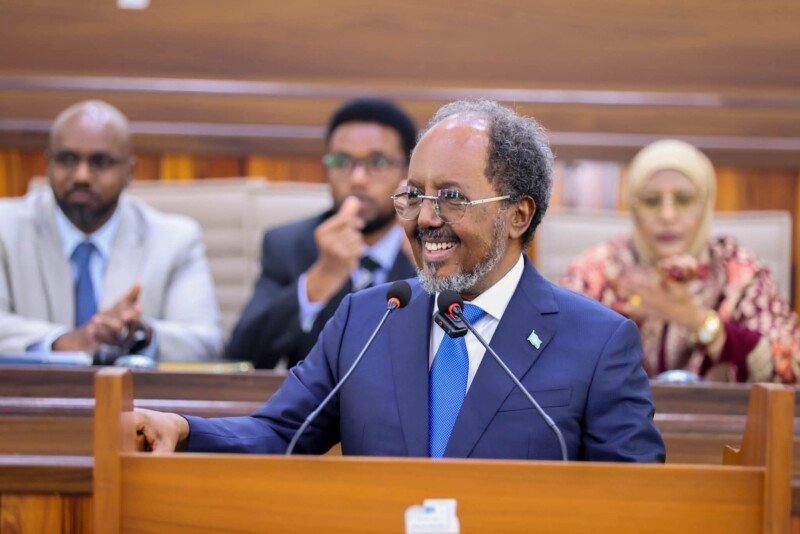
MOGADISHU – President Hassan Sheikh Mohamud has declared that Somalia is using all available diplomatic, security and international cooperation tools to counter what he described as an Israeli “incursion” into the country, warning that the federal government will not allow Middle East conflicts to be imported into the Horn of Africa.
In an address to the Federal Parliament on August 1, the president said Somalia’s opposition to any Israeli presence on Somali soil has been made clear on every international platform and directly to the Somali people. “We have not hidden it. We have stood against it on every world stage, and we have told our people,” he said. “We are working with force, strategy, diplomacy and international cooperation. We are using them to ensure this does not take hold.”
A Defiant Stance Against Israeli Influence
The president’s remarks come seven months after Israel became the first UN member state to formally recognise Somaliland, a move that has drawn widespread condemnation from Mogadishu, the African Union and the Arab League. The recognition, signed by Prime Minister Benjamin Netanyahu and Somaliland President Abdirahman Mohamed Abdullahi Irro, established full diplomatic relations, including the exchange of ambassadors and the opening of embassies.
President Mohamud said Somalia “has not seen and does not see any interest for the Somali people, the region or the Horn of Africa” in the presence of Israel. “For that reason, Somalia always has a loud and clear message for Israel: leave us alone.”
The president also warned against the importation of Middle East conflicts into the Horn of Africa. “The conflict and problems that have persisted in the Middle East for nearly a century cannot simply be brought to the Horn of Africa,” he said. “It is not that easy.”
Force and Diplomacy: A Dual Approach
The president’s statement that Somalia is using “force, strategy, diplomacy and international cooperation” to counter Israeli influence is a significant departure from the government’s previous public posture, which had emphasised dialogue and international legal measures. President Mohamud had previously revealed that the federal government weighed military action as a potential response to Israel’s recognition of Somaliland but ultimately chose dialogue and persuasion.
The shift toward a more assertive posture suggests that Mogadishu’s diplomatic efforts have not yielded the desired results. Somalia has refused to renew airspace entry permits for the Israeli airline Arkia, effectively blocking its operations over the Horn of Africa, a move analysts view as the first concrete act of diplomatic retaliation, the the government have not officially acknowledged this measure. Mogadishu has issued stark warnings to Israel, stating that it reserves the right to take all necessary measures against Tel Aviv over its expanding engagement with Somaliland.
However, the effectiveness of these measures is questionable. Somaliland has already opened an embassy in Jerusalem and established formal diplomatic relations with Israel. Israel has confirmed it secretly worked with Somaliland for years before the public recognition, and CNN has reported that Somaliland provided Israel with a covert military position during the recent war with Iran. The UAE, which has cultivated significant economic and security ties with Somaliland, is widely seen as having facilitated the Israeli breakthrough.
A Pattern of Condemnation Without Consequence
The president’s address is the latest in a series of Somali condemnations of Israeli engagement with Somaliland. In January, President Mohamud cautioned that Israel’s recognition of Somaliland could import Middle East tensions into the Horn of Africa and warned that if Israel uses Somaliland as a proxy territory to attack others, they may retaliate in Somaliland and Somalia, creating a dangerous dynamic. He has also accused Israel of intending to establish a strategic military presence in the Horn of Africa to extend its control over critical maritime corridors.
The African Union Peace and Security Council has rejected the unilateral recognition of Somaliland by Israel and called for its immediate revocation. The Arab League has formally condemned the visit of Israel’s Foreign Minister to Hargeisa, labeling it a violation of international norms. IGAD has also reiterated its backing for Somalia’s sovereignty, unity and territorial integrity.
Yet these condemnations have not reversed the diplomatic momentum. Israel remains the sole UN member state to have recognised Somaliland, and the engagement between Hargeisa and Tel Aviv continues to deepen. Somaliland has indicated it is prepared to offer Israel rights to valuable mineral deposits in exchange for technology and investment. Somaliland’s president has opened an embassy in Jerusalem, and Israel has formally accepted Somaliland’s first ambassador.
Way Forward
President Mohamud’s address to Parliament reflects the government’s determination to resist Israeli influence in the Horn of Africa. Mogadishu’s diplomatic efforts have failed to reverse Israel’s recognition of Somaliland, and the strategic interests of regional actors like the UAE, which has deepened its ties with Hargeisa, continue to complicate Somalia’s position. The president’s threat to use “force” may be more aspirational than actionable, given Somalia’s limited military capacity and its reliance on international support for its security transition. The question is whether Somalia’s diplomatic campaign can gain sufficient momentum to counter the growing Israeli and Emirati influence in the region, or whether Mogadishu will continue to issue condemnations that are heard but not heeded.
Recommended Reading On ftlsomalia.com
- Israel Officially Recognizes Somaliland as Independent Sovereign State
- Somalia Weighed Military Action but Chose Dialogue After Israel’s Recognition
- Mogadishu Cautions Israel Over Somaliland Engagement
- Somalia Denies Airspace to Israeli Airline Following Recognition
- Israel Says It Secretly Worked With Somaliland for Years
- Somaliland Eyes Trade Pact with Israel; Offers Mineral Rights in Exchange for Tech