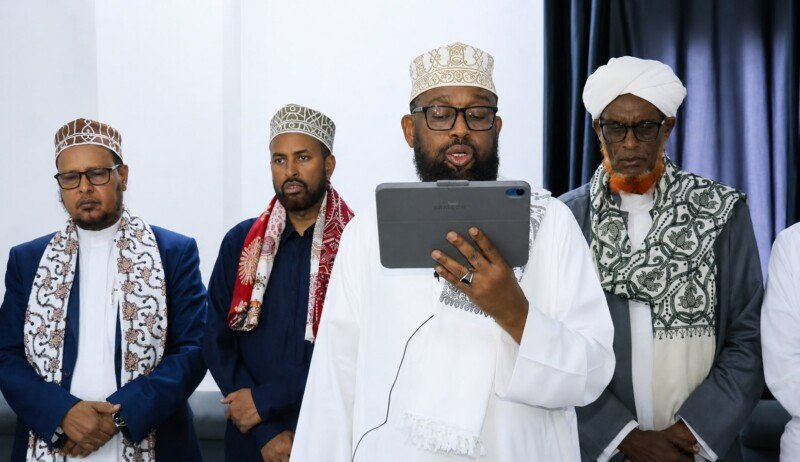
MOGADISHU — The Union of Somali Islamic Scholars Councils has called on the federal government to halt actions that deprive citizens of their property rights, amid growing complaints over land disputes, demolitions, and forced evictions in parts of the capital.
The scholars held a meeting in Mogadishu to address numerous complaints from residents who said their properties were being demolished or contested despite holding legal ownership documents. The group said it had received complaints alleging that property owners had lost their land or homes, while others had been subjected to fees lacking a clear legal basis.
The religious leaders stressed that private property should not be taken through administrative orders, the exercise of authority, or intimidation without due legal and judicial procedures. They urged President Hassan Sheikh Mohamud, Prime Minister Hamza Abdi Barre, the Banadir regional administration, and relevant government institutions to independently investigate the complaints, protect citizens’ property rights, and hold accountable anyone found to have abused their authority, engaged in land grabbing, or committed corruption.
The scholars also called on the judiciary to handle land disputes independently and fairly, while warning businessmen, notaries, and property brokers against involvement in property obtained through injustice or unlawful means. The union said it would consider further measures if the complaints were not addressed promptly.
Former President and opposition leader Sheikh Sharif Sheikh Ahmed has issued a stark warning that the country’s fragile statehood is “on the brink of collapse” due to what he called rampant and unlawful land seizures by politically connected elites. Speaking during a meeting with residents recently displaced from their homes, Sharif accused influential businessmen and well-placed officials of orchestrating widespread land grabs across the capital and beyond, describing the practice as “a dangerous betrayal of the public trust” that undermines stability.
A Somali internet service provider, SOON, has accused members of the presidential guard of raiding and demolishing its main network hub in Mogadishu’s Bondhere district, escalating concerns over alleged land seizures near the presidential palace. The company said the guards arrived with heavy machinery and tore down key infrastructure that housed vital network equipment, disrupting services for hundreds of customers in central Mogadishu. Parliamentarian Qali Shire is said to be claiming the property, raising questions about the involvement of powerful figures in contested land cases around Villa Somalia.
Escalating Land Crisis in Mogadishu
Families in Mogadishu’s Wabari district took to the streets to protest forced evictions, with demonstrators criticising President Hassan Sheikh Mohamud and accusing Turkey of supporting what they described as a “bloody hand” in Somalia. Somali government forces used live ammunition against residents resisting eviction from their homes, according to reports. “We have nowhere to go. We are civilians. We are being robbed,” a woman said while protesting the forced evictions in Wabari.
Heavy fighting erupted in the capital when rival security factions clashed over government attempts to demolish the Warlaliska neighborhood in Daynile district. The area is home to thousands of low-income families, many of whom depend on daily income from the Bakaro market. Witnesses reported heavily armed forces entering the neighborhood with bulldozers and attempting to demolish houses while some residents remained inside, refusing evacuation orders. The incident sparked intense gun battles that reverberated across Mogadishu throughout the evening, with continuous gunfire exchanges involving heavy weapons.
Tensions have risen in Siliga Towfiiq, Yaqshiid district, where dozens of families have staged protests against what they describe as systematic land grabs by powerful business interests. Residents accuse individuals of fraudulently selling off their homes and plots of land, leaving many households without shelter. Community elders and affected families report that the disputed lands were originally state-owned, allocated decades ago to government workers and vulnerable citizens.
Former President Sharif Sheikh Ahmed has strongly criticized the federal government’s eviction campaign, describing the operation as “unlawful, unplanned, and contrary to Islamic values” and urging the authorities to halt it immediately. “The forceful removal of citizens without due process, compensation, or transparency is a violation of both national law and Sharia principles. Public land belongs to the people, not to a few individuals in government who act without accountability,” Sharif said.
Former President Mohamed Abdullahi Farmaajo has accused the federal government of attempting to restrict and suppress planned demonstrations, warning that preventing peaceful assemblies could violate citizens’ constitutional rights. Security authorities instructed protesters to gather at Koonis Stadium, while opposition parties demanded the right to assemble in multiple Mogadishu neighbourhoods, particularly those affected by demolitions and land disputes.
MP Abdirahman Abdishakur Warsame has previously warned that forced evictions in Mogadishu could fuel extremism, saying the government’s actions risk creating a humanitarian and security catastrophe. “This isn’t just about homelessness; it’s about national security,” Abdishakur said, warning that the government’s campaign was “handing Al-Shabaab a powerful recruitment tool on a silver platter.” He emphasised that when citizens are stripped of their homes, dignity, and livelihoods without due process, the resulting despair becomes fertile ground for extremist groups seeking to exploit grievances.
Abdirahman Abdishakur has welcomed the scholars’ statement, stating that speaking out against injustice is an important step, but this responsibility cannot rest on religious scholars and politicians alone. Business leaders, professional associations, academics, traditional elders, civil society, women, and youth must also speak out against land grabbing, displacement, abuse of power, and the misuse of public assets. “Injustice does not stop with today’s victims. It erodes public trust, weakens institutions, fuels grievances, and ultimately threatens the state itself. Defending citizens from injustice is not separate from state-building; it is fundamental to it. A state cannot be built on injustice; it must be built on justice, accountability, trust, and the rule of law.”
Historical Context and Governance Concerns
Land ownership has long been one of Somalia’s most contentious issues, often sparking violent clashes between communities, private developers, and armed groups. The collapse of the state in 1991 left a large number of government properties vacant and derelict. Today, Mogadishu is experiencing a property boom that has raised the value of public land as new hotels and high-rises continue to be constructed.
Land disputes have also flared in rural areas. Armed militias from the Mataan Abdulle clan held a show of force in protest against what they claim is an illegal land grab for the construction of a satellite base near the coastal town of Warsheikh in the Middle Shabelle region. Clan elders and armed supporters gathered near the disputed site, denouncing what they described as a violation of traditional land rights and lack of consultation with local communities.
The United Nations has warned that more than 142,000 internally displaced people have been forcibly evicted from temporary shelters since the start of 2025, with the majority of those evictions taking place in urban settlements across Mogadishu, Baidoa, and Kismayo. Humanitarian organizations have described repeated evictions as activities that exacerbate vulnerabilities and cut families off from essential services such as food assistance, healthcare, and education.
Critical Note
The Union of Somali Islamic Scholars’ call for an investigation into land disputes and property demolitions highlights the deep and growing crisis over land governance in Mogadishu. The scholars’ intervention comes at a time when the federal government is facing increasing criticism from opposition figures, civil society groups, and displaced residents over urban redevelopment and land clearance operations. The government’s handling of these issues reflects a broader pattern of governance failures that undermine the rule of law and erode public trust.
The allegations of politically connected land grabs, the use of security forces to evict residents, and the involvement of presidential guards in demolishing private property raise serious questions about the government’s commitment to protecting the rights of its citizens. As former President Sharif warned, unchecked land seizures could inflame social grievances and create fertile ground for instability. The international community must urge the government to ensure that land disputes are resolved through transparent legal processes, and that those responsible for abuses of power are held accountable.
As Abdirahman Abdishakur noted, “A state cannot be built on injustice; it must be built on justice, accountability, trust, and the rule of law.” The government’s response to these concerns will be a critical test of its commitment to those principles.
Recommended Reading On ftlsomalia.com
- Mogadishu Residents Protest Forced Evictions in Wabari District
- Internet Firm Accuses Presidential Guards of Destroying Hub in Mogadishu Land Dispute
- Families in Yaqshiid Protest Alleged Land Grabs, Call on President to Act
- Mogadishu Violence Erupts as Security Forces Clash Over Evictions
- Ex-President Sharif Warns Somalia Risks Collapse Amid Elite Land Grabs
- Ex-President Says Government’s Eviction Drive in Mogadishu is “Unlawful”