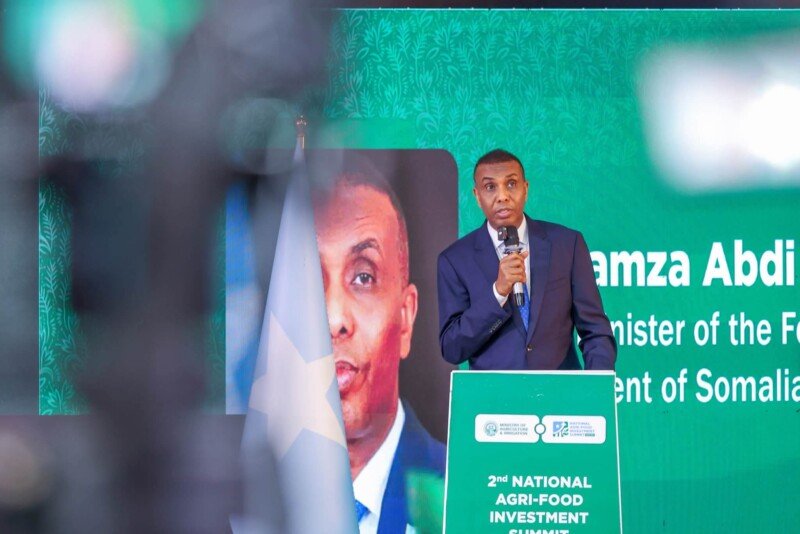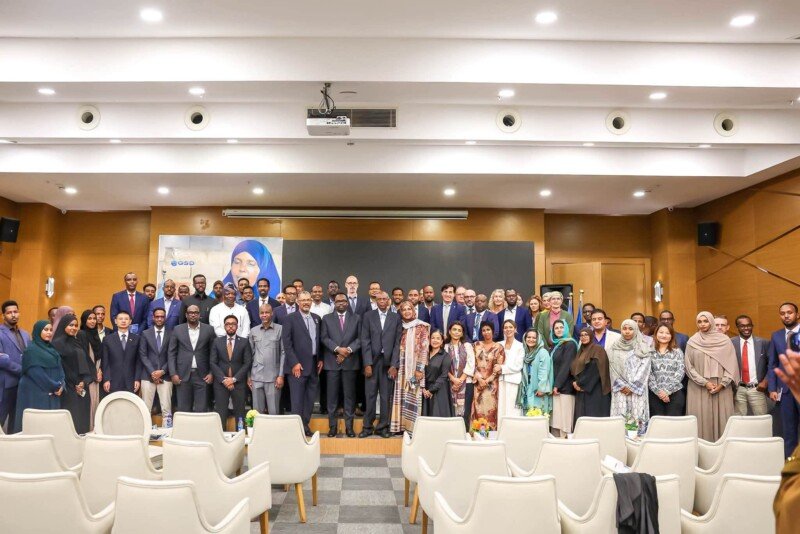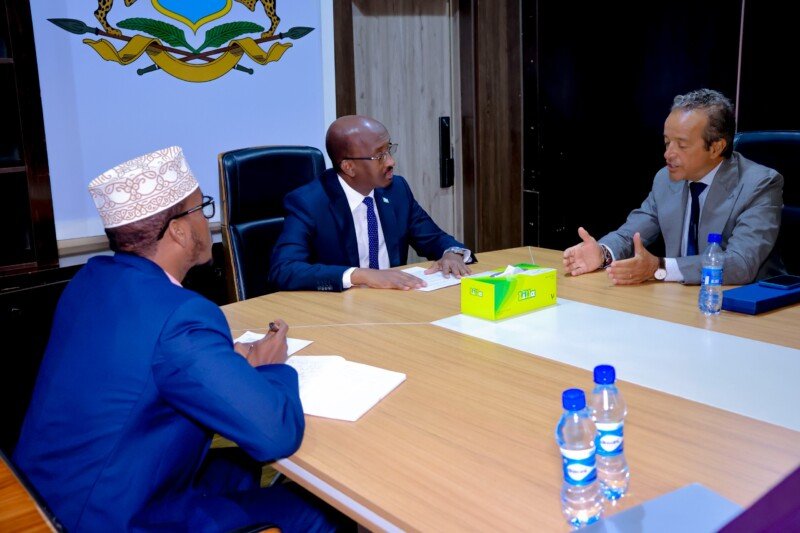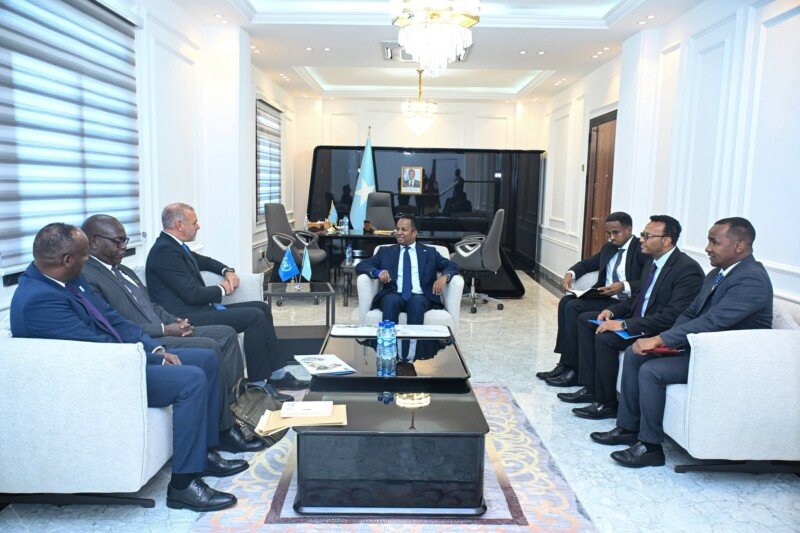
MOGADISHU — The Minister of Foreign Affairs and International Cooperation, Abdisalam Abdi Ali, has received the letters of credence from the new United Nations Development Programme (UNDP) Resident Representative for Somalia, Christophoros Politis, at the Ministry’s headquarters in Mogadishu.
Following the presentation of credentials, Politis held a meeting with the Permanent Secretary of the Ministry, Hamza Adan Haadoow, during which the two sides signed a Memorandum of Understanding (MoU) establishing a framework to strengthen cooperation in support of Somalia’s development priorities.
The two sides reaffirmed their commitment to deepening development cooperation and welcomed the continued support of UNDP for the development of Somali government institutions and the country’s sustainable growth.
Somalia and UNDP have maintained a robust partnership focused on strengthening economic resilience, advancing climate adaptation, and promoting sustainable development initiatives across the country [citation:4].
UNDP has been instrumental in supporting Somalia’s economic recovery through initiatives focused on job creation, small business development, and sustainable livelihood projects aimed at reducing dependence on aid while encouraging self-reliance [citation:12].
UNDP’s Role in Somalia’s Development
The United Nations Development Programme has been a key partner in Somalia’s recovery and development, providing technical assistance and capacity building across multiple sectors, including governance, rule of law, economic development, and environmental sustainability. UNDP’s support has focused on strengthening government institutions, promoting inclusive governance, and advancing the Sustainable Development Goals (SDGs) in Somalia.
UNDP has signed a five-year partnership agreement with the Ministry of Youth and Sports focusing on youth development, peace and security, skills development, climate action and youth employment, reflecting the agency’s commitment to addressing challenges facing Somalia’s young population [citation:1].
UNDP has also been instrumental in advancing justice sector reforms through the Joint Justice and Corrections Programme (JJCP), a flagship initiative aimed at strengthening the rule of law in Somalia [citation:8].
UNDP has supported Somalia’s climate resilience efforts, including the launch of the Multi-Hazard Early Warning System under the global Early Warnings for All framework, which aims to reduce disaster-related deaths and extend early warning coverage across the country [citation:6].
UNDP has also been training local government officials to strengthen grassroots governance and fiscal transparency, with a focus on citizen participation and gender-responsive budgeting [citation:13].
Critical Note
While the signing of the MoU between Somalia and UNDP represents a positive step toward strengthening development cooperation, the effectiveness of this partnership will ultimately depend on implementation and accountability. The government’s ability to coordinate effectively with UNDP and other international partners, and to ensure that development assistance is used efficiently and reaches the most vulnerable communities, will be a critical test of its development governance capacity.
Furthermore, the sustainability of UNDP’s support will require continued commitment from both sides, as well as adequate funding from international donors. Without sustained investment and a genuine commitment to reform, development assistance risks being absorbed by bureaucratic inefficiencies rather than delivering tangible improvements in the lives of ordinary Somalis.
Recommended Reading On ftlsomalia.com
- Somali Finance Minister Meets UN Delegation in Mogadishu
- Somalia and UNDP Forge New Pact to Boost Jobs and Youth Empowerment
- Ministry of Youth and UNDP Sign Five-Year Partnership Agreement
- Somalia, EU, UNDP Discuss Expanding Nationwide Justice Access
- Somalia Introduces Climate Early Warning System
- HirShabelle Officials Trained to Boost Local Governance