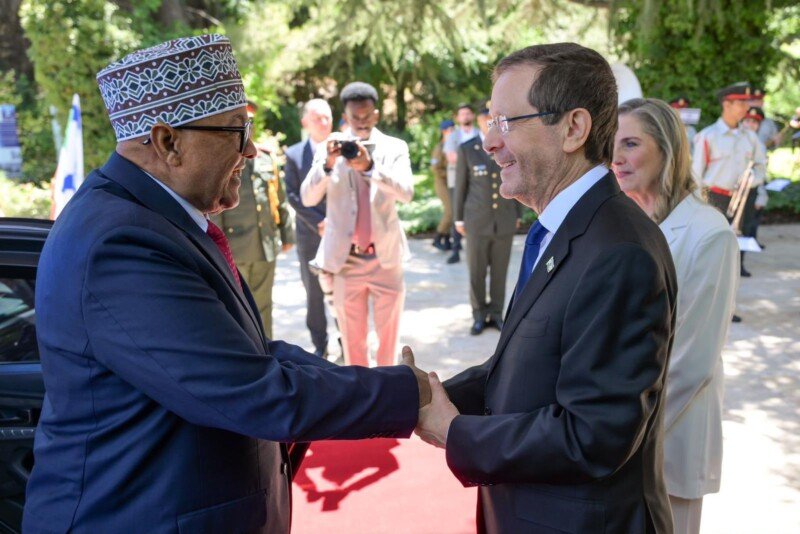
JERUSALEM – Somaliland President Abdirahman Mohamed Abdullahi (Irro) has arrived in Israel for a multi‑day state visit, the first by a sitting leader from the breakaway northern region since Israel recognised Somaliland in December 2025. The trip, which began on 14 June 2026, is portrayed by the Irro administration as the culmination of a decades‑long quest for international legitimacy.Yet the landmark visit unfolds against a backdrop of fierce international opposition, unresolved legal questions and growing concern that Israel is importing Middle East conflicts into the Horn of Africa. Mogadishu has condemned the move as a violation of its sovereignty, while the African Union, the Arab League, Turkey, Egypt and others have all rejected the recognition and called for its immediate revocation.
Mixed Messages on Recognition
The main events of the visit include a formal welcome by Israeli President Isaac Herzog, a state luncheon attended by Foreign Minister Gideon Sa’ar, the opening of a self‑styled Somaliland embassy in Jerusalem on Monday evening, and planned talks with Prime Minister Benjamin Netanyahu. Somaliland also intends to participate in an economic forum organised by the Israeli Export Institute.
However, the diplomatic breakthrough remains on shaky legal ground. Former Somali intelligence chief Fahad Yasin has argued that the recognition has no legal weight, noting that it was not passed by the Israeli executive or the Knesset and that it has no basis in Israel’s own charters or laws. “If Netanyahu leaves office or any new developments occur in the region, a new decree could be issued to reverse it, or it could simply be ignored,” Yasin wrote.
Mogadishu has maintained that the recognition is “null and void”. Somalia’s Foreign Minister Abdisalam Abdi Ali told an emergency session of the African Union Peace and Security Council that the move violates Somalia’s provisional constitution, the AU Constitutive Act and the UN Charter, warning that eroding Somalia’s integrity would destabilise the Horn of Africa and undermine regional counter‑terrorism and maritime security.
Somalia Warns of Middle East Conflict Spillover
President Hassan Sheikh Mohamud has repeatedly cautioned that Israel’s engagement with Somaliland risks importing the Middle East’s conflicts into the Horn of Africa. In an interview with TRT World, Mohamud said Somalia has never attacked Israel and does not want Israeli‑related conflicts brought to Somali soil, calling the situation deeply regrettable.
He warned that an Israeli military presence in Somaliland could reignite conflict around the Gulf of Aden and the Red Sea, especially given the hostile relations that Yemen’s Houthis and Iran have with Israel. “If Israel uses Somaliland as a proxy territory to attack others, they may retaliate in Somaliland and Somalia, creating a dangerous dynamic,” Mohamud said. He further vowed that Somalia would “confront any Israeli forces coming in” if Tel Aviv attempted to establish a military base in the breakaway region.
Covert Military Position Reported
The concern over military activity is not hypothetical. A CNN investigation published earlier this month revealed that Somaliland provided Israel with a covert military position during the recent war with Iran, allowing Israeli aircraft a potential stopping point on long‑range flights. The report described how Israel secretly deployed elite military and intelligence units to several countries, including Somaliland, extending its reach hundreds of miles into Iranian territory.
The port of Berbera, already developed by the UAE’s DP World, is at the heart of this strategic competition. Israel has reportedly considered establishing a permanent military presence there to protect Red Sea shipping lanes. Djibouti’s President Ismail Omar Guelleh has warned that an Israeli base in Berbera would directly threaten stability throughout the Horn of Africa, accusing Israel of exploiting Somaliland’s quest for recognition to secure a foothold in the volatile region.
Diplomatic Isolation, Not a Global Breakthrough
Despite the celebratory tone in Hargeisa and Jerusalem, the international community has largely rebuffed the recognition. The African Union, IGAD, Qatar, Saudi Arabia, Jordan, Iraq and China were among the first to condemn the move. Even the United States, while not condemning the recognition, reaffirmed its “One Somalia” policy and declined to follow Israel’s lead.
Sixteen Arab and Muslim nations, including Egypt, Turkey, Pakistan, Indonesia and the United Arab Emirates, issued a joint statement condemning the planned Somaliland embassy in Jerusalem, calling it an unacceptable provocation and a flagrant violation of international law. The ministers also reaffirmed their full support for the unity, sovereignty and territorial integrity of the Federal Republic of Somalia.
The visit by Israeli Foreign Minister Gideon Sa’ar to Hargeisa in January 2026 was described by Mogadishu as an “unauthorised incursion” and a “blatant assault” on Somali sovereignty. The Somali government appealed to the UN, AU and Arab League to intervene, warning that Israel’s actions constitute unacceptable interference in the internal affairs of a sovereign state.
Accusations of Infiltration and Internal Divisions
Concerns about Israeli influence extend beyond Somaliland. Former Information Minister Zakaria Mahmoud Hajji has alleged that Israel has deeply infiltrated Somalia’s federal institutions and political decision‑making processes. He warned that Israel’s presence in Berbera represents “a dagger in the back of the entire region” and argued that Israel penetrates Somalia through Ethiopia, where the two countries’ interests have converged.
Even within the breakaway region, the recognition is not universally welcomed. Religious leaders and some political figures in Somaliland have expressed unease about forging ties with Israel, given the deep‑seated cultural and religious sensitivities within Somali society. Hargeisa has dismissed such criticism, arguing that it is exercising its sovereign right to establish diplomatic relations.
The Bottom Line
For President Irro, the visit to Jerusalem is a carefully orchestrated statement that Somaliland is no longer waiting on the fringes of the global order. Yet the tangible dividends of the alliance remain uncertain. No other UN member state has followed Israel’s lead, and major powers such as the United States, the United Kingdom and France continue to support Somalia’s territorial integrity. Meanwhile, the prospect of an Israeli military base in Berbera has drawn sharp warnings from Mogadishu, Djibouti and even the Houthis, who have threatened to treat any Israeli installation as a legitimate military target.
The coming days will show whether the visit translates into lasting economic or security cooperation, or whether it deepens the region’s geopolitical fault lines without delivering the breakthrough that Hargeisa has sought for 35 years.
Recommended Reading On ftlsomalia.com:
- Somaliland to Open Jerusalem Embassy as Second Muslim Nation in Israel Deal
- Former Spy Chief Claims Somaliland’s Israel Recognition is Legally Void
- Mogadishu Cautions Israel Over Somaliland Engagement
- President Mohamud Threatens to ‘Confront’ Any Israeli Military Presence in Somaliland
- CNN: Somaliland Provided Covert Military Position to Israel During Iran War
- Djibouti Warns Israeli Somaliland Base Threatens Regional Stability
- Foreign Minister Speaks at AU PSC on Somalia’s Territorial Integrity
- Somali Ex-Minister Accuses Israel of Infiltrating Somali Institutions
- Diplomatic Earthquake: Israeli Foreign Minister’s Historic Visit to Hargeisa Sparks Sovereignty Crisis
- 16 Arab and Muslim Nations Condemn Somaliland’s Alleged Plan for Jerusalem Embassy