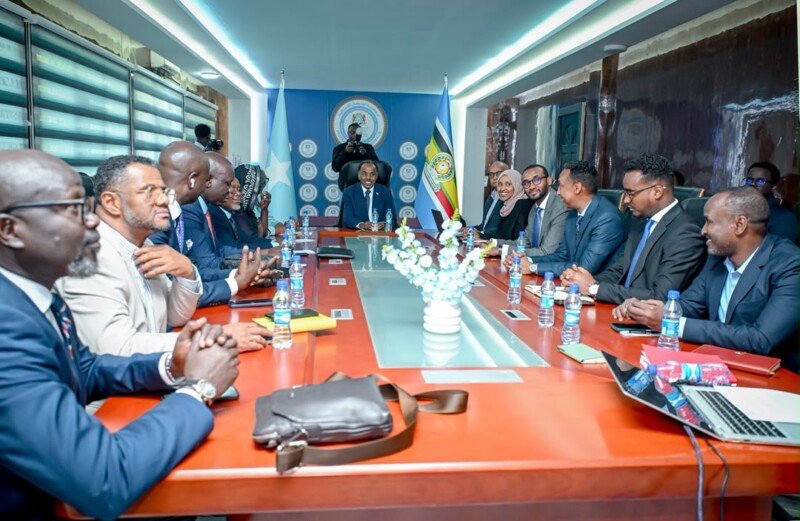
MOGADISHU — Somalia’s Second Deputy Prime Minister, Jibril Abdirashid Haji, has surrendered his Kenyan passport, becoming the first senior government official to publicly comply with President Hassan Sheikh Mohamud’s directive requiring ministers and senior officials holding Kenyan travel documents to relinquish them or leave office.
In a video statement shared on social media, Haji confirmed that he had handed over the passport to Kenya’s Deputy Ambassador to Somalia, Elias Bare Shill, at a ceremony in Mogadishu on Monday, August 3, 2026. Haji described the move as a voluntary decision aimed at upholding transparency and accountability among government officials. Haji had previously denied deportation claims and urged the media to avoid unverified reports about his travel difficulties.
Presidential Directive and Cabinet Tensions
The surrender follows a directive President Hassan Sheikh Mohamud issued during a Cabinet meeting in Mogadishu on Thursday, July 30, 2026. The president instructed ministers and senior officials holding Kenyan passports or national identity cards to surrender them immediately, giving them a choice between retaining their government positions or keeping their Kenyan documents. Officials were told they could not continue serving in senior public office while retaining those passports.
However, the directive did not pass without resistance. Several ministers reportedly challenged the president’s position during the meeting, arguing that Somalia’s legal framework recognizes dual citizenship and contains no provision barring public officials from holding more than one nationality. Those who objected maintained that possessing a second passport does not disqualify an individual from serving in government, and that no existing law requires Cabinet members to renounce foreign citizenship as a condition of office.
Background: Deportation and Diplomatic Tensions
The passport dispute has its roots in a diplomatic incident that occurred on June 24, 2026, when Haji was denied entry and deported from Kenya’s Jomo Kenyatta International Airport (JKIA). The diplomatic incident drew significant attention, with Haji arriving at JKIA using a valid Somali diplomatic passport with a valid visa, but immigration officers questioned him over a Kenyan passport they suspected had been fraudulently obtained. The report said Haji acknowledged possessing the passport but declined to surrender it, insisting the matter would only be resolved through a court process. He was subsequently placed on a return flight to Mogadishu.
The controversy deepened when Somalia’s State Minister at the Presidency, Abshir Bukhaari, was also reportedly denied entry at Nairobi’s airport after immigration officials questioned a Kenyan passport he was said to be carrying. Somali media reported that Kenyan immigration authorities placed approximately 30 Somali government officials on airport watchlists, resulting in several refusals of entry in recent weeks.
In response, Somalia’s Ministry of Foreign Affairs summoned Kenya’s ambassador to Mogadishu to seek an explanation over the treatment of the senior officials. Somalia formally summoned the Kenyan ambassador to address the treatment of senior officials, though Kenyan authorities have not publicly confirmed that such a meeting took place.
President’s Warning: ‘Any Official Arrested Abroad Will Be Dismissed’
In a public address, President Mohamud made one of his strongest statements on government accountability, declaring that any Somali government official arrested abroad while traveling on a passport issued by another country would be immediately dismissed from office. The president warned officials against using foreign passports, making clear that anyone arrested abroad while carrying that country’s passport would face immediate dismissal. “Any government official who is arrested in another country while carrying that country’s passport will be removed from office immediately,” the president said.
Although the president did not identify any individual or refer to a specific incident, the remarks were interpreted as a warning to senior government officials who hold Kenyan citizenship. The president stressed that holding public office comes with responsibilities that extend beyond Somalia’s borders, and that officials entrusted with representing the federal government must avoid actions that could undermine the country’s reputation or public confidence in state institutions.
The issue of dual citizenship has periodically surfaced in Somali politics, with supporters emphasizing the contributions of the diaspora to national reconstruction, while critics argue that senior officials should demonstrate exclusive loyalty to the Somali state. The deportation of the deputy prime minister over the passport dispute highlighted the growing tensions and the need for clear policies on dual citizenship among senior officials.
Haji’s Response and the Legal Distinction
In his statement, Haji stressed that the Kenyan passport had been legally issued to him and that he had used it lawfully during the period he held it. He insisted that his decision was not prompted by a dispute or a request from the Kenyan government, but was a personal choice aimed at demonstrating his commitment to his official responsibilities.
Haji also emphasized that the move should not be interpreted as hostility toward Kenya, which he described as a close friend, partner, and brotherly nation with deep historical, social, and economic ties to Somalia. He acknowledged Kenya’s decades of support for Somali communities, including hosting refugees, providing educational opportunities, facilitating trade, and welcoming Somali businesses. “Kenya and its people remain our brothers and our friends,” he said.
However, legal experts note a crucial distinction: surrendering a passport and renouncing citizenship are not the same. A passport is a travel document, while citizenship is a legal status. Under Kenyan law, renunciation requires a formal declaration and approval by the relevant authorities, meaning that handing over a passport alone does not necessarily terminate citizenship. That distinction could prove significant, as any investigation into how the passport was obtained could continue independently of Haji’s current legal status.
Haji confirmed that he would continue traveling on a Somali diplomatic passport and expressed confidence in Somalia’s national documents. He also addressed Somali citizens who have reported difficulties while traveling, particularly through Jomo Kenyatta International Airport, urging them to remain confident in their nationality. “I understand the concerns and difficulties that some citizens have experienced,” he said. “But I encourage Somalis to have confidence in their citizenship and to proudly rely on their Somali passport.”
Critical Note
While Deputy Prime Minister Haji’s surrender of his Kenyan passport represents a significant step toward compliance with the presidential directive, the episode raises broader questions about governance, accountability, and the rule of law in Somalia. The president’s warning that officials will be dismissed if arrested abroad while carrying foreign passports, while politically compelling, lacks clear legal grounding. Somalia’s laws recognize dual citizenship, and no existing legislation explicitly bars senior officials from holding foreign travel documents. The directive appears to be an executive order rather than a legally mandated requirement, raising concerns about due process and the potential for selective enforcement. Furthermore, the distinction between surrendering a passport and renouncing citizenship means that Haji’s action may be more symbolic than substantive. The controversy has also exposed divisions within the Cabinet, with several ministers reportedly challenging the president’s authority on this matter. The government would be well advised to pursue a legislative approach to this issue, rather than relying on executive directives that may be contested or unevenly applied. Without clear legal frameworks and consistent enforcement, such measures risk being perceived as political theater rather than genuine accountability, and may further strain Somalia’s relationship with Kenya at a time when both countries face shared security challenges.