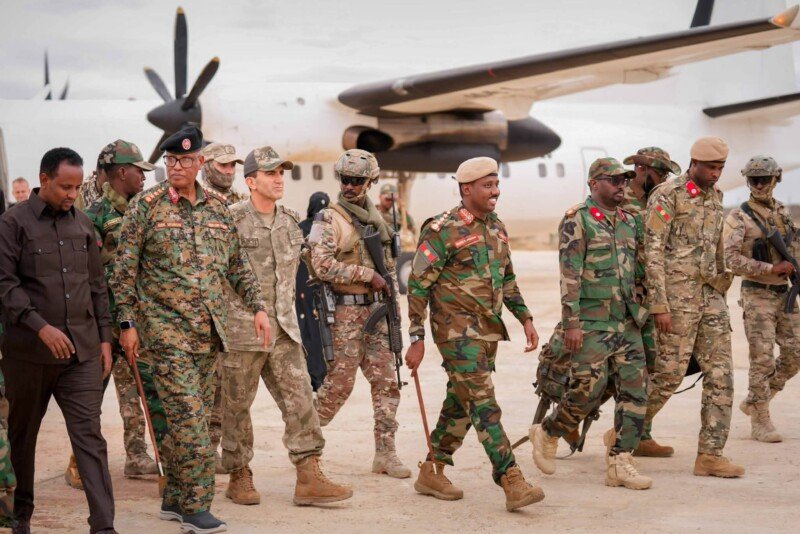
BAIDOA — The Commander of the Somali National Army, Major General Ibrahim Mohamed Mohamud, has arrived in Baidoa, the interim administrative capital of the South West State, leading a high-level military delegation aimed at accelerating ongoing operations against Khawaarij militants in the Bay region.
The delegation was received at Baidoa airport by senior military officers and officials from the South West State administration. The Commander was accompanied by the Commander of the Turkish-Somali Task Force (TURKSOM), General Sebahattin Kalkan, the Deputy Chief of the Somali National Army, General Madeey Nur Sheikh Ufurow, and the Chairman of the Military Court, Senior Colonel Hassan Ali Nur Shuute.
The visit is focused on intensifying counter-insurgency efforts and boosting the morale of Somali National Army troops stationed on the frontlines in the Bay region, which has been a focal point of military operations against Al-Shabaab in recent months. The army’s elite Danab Commandos have conducted planned operations in the Bay region, destroying militant hideouts and positions in areas including Buur Aylo, Jameeco, Durdur and Saaxweyne.
Strategic Significance of the Visit
Baidoa, the capital of the Bay region, is strategically located approximately 250 kilometers northwest of Mogadishu and has long been a key battleground in the fight against Al-Shabaab. The city serves as the de facto capital of the South West State and has been the site of repeated military operations aimed at securing the surrounding areas from militant control.
The presence of the Turkish military commander alongside the Somali army chief underscores the deepening security partnership between Somalia and Turkey. TURKSOM, the Turkish military training mission in Somalia, has played an increasingly prominent role in building the capacity of Somali forces, including the training of the elite Gorgor commando brigades. Defence Minister Ahmed Moallim Fiqi recently held talks with his Turkish counterpart at the SAHA 2026 Defence Industry Fair in Istanbul, exploring ways to enhance defense collaboration and improve the capabilities of the Somali National Armed Forces. General Kalkan’s participation in the front-line visit signals Turkey’s continued commitment to supporting Somalia’s counter-terrorism efforts.
The visit also comes amid a broader push by the Federal Government to consolidate security gains and expand territorial control ahead of planned offensives in the region. The Bay region has witnessed a series of operations in recent months, including coordinated ground assaults and airstrikes targeting Al-Shabaab positions. Somali forces have recently killed 22 Al-Shabaab militants, including a commander, in operations in the Lower Shabelle region, demonstrating the military’s continued offensive posture across multiple fronts.
Regional Context and Security Challenges
The South West State has been a focal point of political rivalries and military operations against Al-Shabaab. South West State Leader Sheikh Aadan Mohamed Nur (Madoobe) has chaired high-level security meetings in Baidoa, aimed at consolidating authority and addressing persistent security challenges in one of Somalia’s most volatile federal member states. The region’s instability has been compounded by tensions between the federal government and regional administrations, as well as ongoing clan dynamics that have complicated counter-terrorism efforts.
The visit by the army chief and his delegation is intended to demonstrate federal commitment to securing the region and to reassure both military personnel and local communities of the government’s resolve. However, the effectiveness of military operations in the Bay region has been mixed, with Al-Shabaab maintaining the ability to launch attacks and disrupt supply routes despite sustained pressure.
In recent weeks, Somali forces have conducted operations in the Daynuunay area near Baidoa, reportedly clearing roadblocks set up by militants and inflicting casualties on Al-Shabaab fighters. These operations are part of a wider campaign to secure the region ahead of the rainy season, which typically hampers military mobility.
The role of international partners, including Turkey and the United States, has been critical in supporting Somali forces with training, equipment, and intelligence. The presence of General Kalkan in Baidoa highlights the importance of Turkish military assistance, which has focused on building the operational capacity of Somali special forces. Somali forces and Turkish advisers have conducted joint humanitarian operations in areas recently liberated from militant control, reflecting a broader counter-insurgency doctrine that blends kinetic action with community engagement.
The government has urged civilians near Al-Shabaab strongholds to remain vigilant and avoid areas that could be targeted in ongoing operations, as military campaigns intensify across multiple regions.
Critical Note
While the visit of the army chief and his Turkish counterpart to Baidoa sends a strong signal of military resolve, the persistence of Al-Shabaab in the Bay region raises questions about the sustainability of current counter-terrorism strategies. Despite years of international support and repeated offensives, the group continues to maintain a significant presence in rural areas, exploiting clan grievances and governance deficits to recruit and operate. The reliance on conventional military tactics, while necessary, has not been matched by comparable investments in stabilization, service delivery, and inclusive governance. Without addressing the underlying drivers of conflict, including marginalization, corruption, and weak rule of law, military gains risk being temporary. The visit of senior commanders, while symbolically important, will not by itself translate into lasting security unless accompanied by a coherent political strategy that addresses the grievances that sustain the insurgency. The government would be well advised to ensure that military operations are complemented by efforts to build trust with local communities and deliver tangible improvements in their daily lives.
Recommended Reading On ftlsomalia.com
- Somali Forces Kill 22 Al-Shabaab Militants, Including Commander, in Lower Shabelle
- South West State Leader Chairs Security Meeting Amid Constitutional Title Dispute
- SNA’s Elite Danab Unit Targets Al-Shabaab Strongholds in Buur Aylo, Jameeco and Durdur
- Somalia’s Defense Minister Holds Talks with Turkish Counterpart at SAHA 2026 Defence Fair
- Somali Army, Turkisom Launch Joint Humanitarian Operation in Mubarak
- Somalis Living Near Al-Shabaab Bases in HirShabelle Told to Leave as Airstrikes Continue