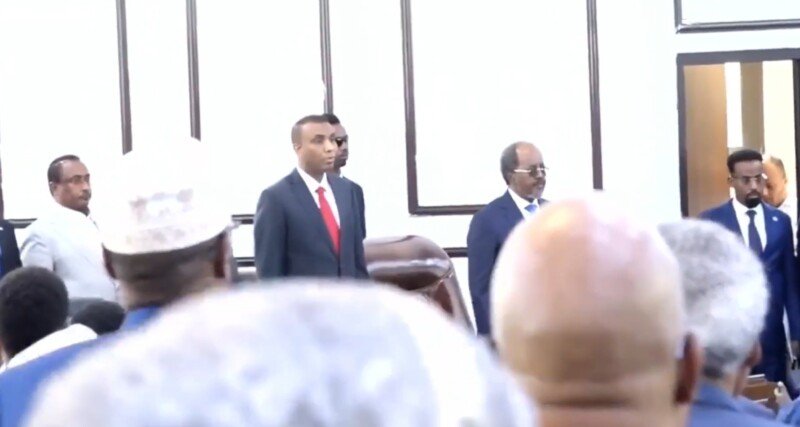
MOGADISHU – President Hassan Sheikh Mohamud has used the opening of the eighth session of the Federal Parliament to lay out his administration’s priorities, addressing everything from election plans and security reforms to higher education and the government’s opposition to what he described as Israel’s efforts to establish a lasting influence in Somaliland. The address, delivered on Saturday at Villa Hargeisa, comes at a time of deep political uncertainty, with the position of Speaker of the House of the People remaining vacant and political tensions simmering between Mogadishu and regional states.
A Defiant Stance on Somaliland and Israel
In one of the most closely watched portions of his speech, President Mohamud said the Federal Government was employing diplomatic and political measures to prevent Israel from gaining what he described as a permanent foothold in Somaliland, adding that the issue remained a key priority for his administration. The remarks come seven months after Israel became the first UN member state to formally recognise Somaliland, a move that has drawn widespread condemnation from Mogadishu and its regional allies.
The president’s comments reflect the government’s broader strategy of using diplomatic channels to counter what it perceives as a campaign by Israel and the United Arab Emirates to secure international recognition for the breakaway region. However, the effectiveness of this approach remains uncertain. Israel has already opened an embassy in Jerusalem and established formal diplomatic relations with Somaliland, while the UAE has maintained close ties with Hargeisa, including significant investments in the port of Berbera and reported military cooperation. The president’s pledge to prevent a “permanent foothold” may be more aspirational than achievable, given the limited leverage Mogadishu holds over the region.
Accountability and the Passport Controversy
The president also made a striking announcement on government accountability, declaring that any Somali government official detained abroad while travelling on a passport issued by another country would be immediately dismissed from office. “Any government official who is arrested in another country while carrying that country’s passport will be removed from office immediately,” the president said.
While the president did not identify any individual or refer to a specific incident, the remarks are being interpreted as a warning to senior government officials who hold dual citizenship. Somalia’s political leadership includes many officials who acquired foreign nationality after living abroad during decades of conflict before returning to take up public office. The statement has sparked debate among politicians, legal experts and members of the Somali diaspora over the responsibilities of dual-national officials.
Critics argue that the president’s comments, while framed as a matter of accountability, could be seen as an attempt to deflect attention from the government’s own failures. The administration has been accused of cronyism and a lack of transparency in its own appointments, and the president’s focus on the conduct of individual officials may be an attempt to shift the spotlight away from broader governance failures. The policy’s implementation also remains unclear, including whether it would require new legislation or administrative directives.
A Parliament at a Crossroads
The parliamentary session opens amid a leadership vacuum, with the position of Speaker of the House of the People remaining vacant following the departure of the previous officeholder. The election of a new Speaker is expected to be Parliament’s immediate priority. In recent days, Mogadishu has witnessed intense political consultations and behind-the-scenes negotiations as lawmakers and political blocs seek to build alliances around potential candidates.
The president reminded lawmakers that the 11th Federal Parliament has only two constitutional sessions remaining, underscoring the need to complete pending legislative and constitutional responsibilities before the end of its mandate. The session also opens against the backdrop of growing political debate over the government’s tenure and the legal mandate of Parliament, with opposition politicians and some legal experts questioning aspects of the current political process. The Federal Government and the Somali Future Council have agreed to resume political dialogue, but Turkey’s efforts to position itself as the sole mediator have been met with resistance from key regional states.
Elections, Security, and Education
On domestic politics, the president said Somalia’s electoral commission had benefited from the experience of Somaliland’s electoral commission as preparations continue for the country’s electoral process. He also criticised sections of the political opposition, saying his administration would not accept what he described as “unrealistic agreements” among opposition leaders. He stressed that political disputes should be resolved through dialogue and constitutional and legal mechanisms.
On security, the president said Somalia was steadily building a self-reliant national security force capable of assuming greater responsibility as African Union forces gradually reduce their presence in the country. He said the government remained committed to strengthening the Somali National Army to ensure the country can independently safeguard its security. The president has previously stated that the national army can operate anywhere in the country, a position that has been met with resistance from regional states.
The president also announced plans to expand access to free public higher education, revealing that the government intends to open a second state-owned university in the near future.
Way Forward
President Mohamud’s address to Parliament laid out an ambitious agenda, touching on security, elections, education, and diplomatic efforts to counter Somaliland’s international recognition campaign. But the gap between rhetoric and reality remains wide. The political deadlock over the speakership, the unresolved tensions with regional states, and the government’s failure to present a credible plan for the security transition all suggest that the president’s promises may be more aspirational than achievable. The eighth session of Parliament will be a test of whether Somalia’s political institutions can rise to the challenges of the moment, or whether they will be consumed by the very divisions they are meant to resolve.
Recommended Reading On ftlsomalia.com
- 8th Session of Somalia’s Federal Parliament Opens Amid Political Uncertainty and Leadership Vacuum
- President Hassan Chairs Cabinet Meeting in Absence of PM Hamza and Deputy
- Somali President Credits U.S. Backing for Dramatic Gains Against Extremism
- Somalia Weighed Military Action but Chose Dialogue After Israel’s Recognition of Somaliland
- Somali President: National Army Can Operate Anywhere in Country
- Opposition Confirms Deal with FGS to Resume Dialogue as Ankara’s Neutrality Questioned