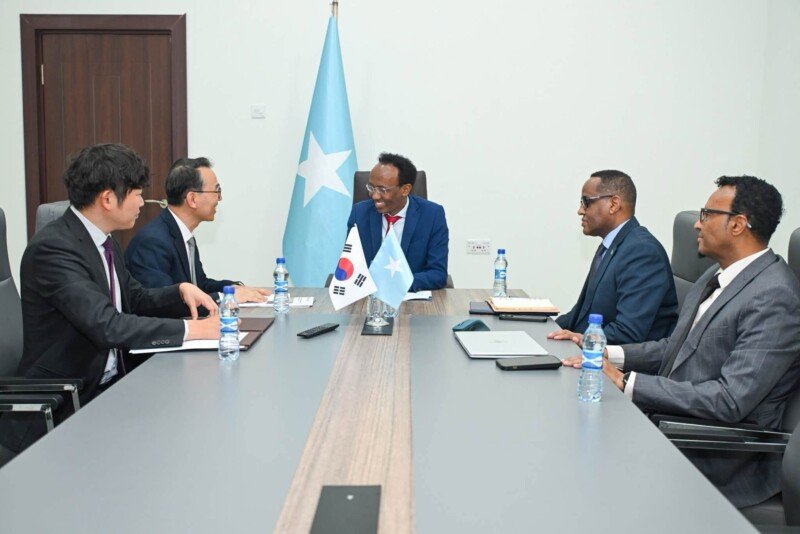
MOGADISHU – Somalia’s Deputy Minister of Foreign Affairs and International Cooperation, Hassan Mohamed Ali, has held talks with South Korean Ambassador to Somalia, Park Ji-Hyun, at his office in the capital, as Mogadishu continues its push to diversify its international partnerships beyond traditional allies.
The two officials discussed strengthening bilateral ties and reaffirmed South Korea’s support for Somalia. They also addressed enhancing maritime security cooperation, capacity building and institutional development, according to a statement from the Somali Foreign Ministry.
A Growing Partnership
The meeting follows a series of high-level engagements that have deepened Somalia-South Korea relations. In June 2026, Somalia’s Minister of Foreign Affairs Abdisalam Abdi Ali attended the Korea-Africa Ministerial Meeting in Seoul, joining colleagues from across the continent for discussions focused on enhancing economic cooperation and diplomatic relations with South Korea. The conference gathered foreign ministers and senior officials to explore methods of enhancing cooperation, promoting sustainable growth, and advancing mutual interests in trade, investment, technology, and international partnerships.
South Korean President Lee Jae-myung met with African foreign ministers, including Somalia’s Abdisalam Abdi Ali, at Cheong Wa Dae, emphasizing the strengthening partnership between Africa and the Republic of Korea. Prime Minister Hamza Abdi Barre has also called for sustainable growth between South Korea and Africa while addressing leaders at the Korea-Africa Summit, highlighting Somalia’s progress and encouraging South Korean investors to invest in renewable energy, natural resources, and agriculture.
South Korea’s Development Footprint in Somalia
South Korea has been steadily increasing its engagement in Somalia through its development agency, KOICA. Wan-kyu Park, KOICA’s Country Director, has emphasized that Somalia’s future stability depends on peace, inclusivity, and opportunities for its people. KOICA has been focusing on programs that address the root causes of conflict and violent extremism, supporting projects that expand vocational training, build entrepreneurship skills, and promote community resilience in regions most affected by instability.
The International Organization for Migration (IOM) and KOICA have launched a multi-country economic recovery project in Somalia, Kenya, and Guinea, aimed at promoting economic recovery, strengthening community resilience, and fostering peace. The initiative provides support for individuals and communities affected by conflicts and economic challenges, focusing on creating livelihood opportunities and improving infrastructure.
A Pattern of Diplomatic Engagement Without Scrutiny
While the meeting between Deputy Minister Hassan Mohamed Ali and Ambassador Park Ji-Hyun reflects Somalia’s active pursuit of new international partnerships, it also raises questions about the transparency of the government’s diplomatic engagement. The Somali parliament has been routinely excluded from reviewing major international agreements, with lawmakers criticizing the executive branch for failing to present deals for scrutiny.
Several Somali federal lawmakers have expressed concerns over a recent judicial agreement with Türkiye, criticizing the government for not presenting past agreements to parliament for review. Member of Parliament Abdirahman Abdishakur Warsame has characterized the oil exploration pact between Somalia and Turkey as “profoundly imbalanced”, warning that it might jeopardize Somalia’s national interests. He disclosed that the present terms grant more than 90 percent of the advantages to one party, leaving Somalia with minimal to no substantial earnings from its own natural resources.
The timing of major agreements coinciding with the impending conclusion of President Hassan Sheikh Mohamud’s administration term has sparked substantial discussion about whether the nation’s long-term wealth is being committed without adequate parliamentary supervision or public accountability. The Somalia Transparency Initiative has called on federal authorities to maintain absolute transparency through the immediate public disclosure of contracts and the implementation of clear, accountable revenue management systems.
Way Forward
Somalia’s engagement with South Korea offers potential advantages in sectors such as technology, digital transformation, skills development, fisheries, renewable energy, and public sector capacity-building. However, the government’s failure to ensure parliamentary oversight and public transparency in its international agreements raises concerns about whether these partnerships will genuinely benefit the Somali people or primarily serve the interests of political elites.
As Somalia continues to deepen its ties with Asian partners, the challenge will be to ensure that these relationships are built on a foundation of accountability and mutual benefit, rather than repeating the pattern of opaque deals that have characterized previous international agreements. Without meaningful parliamentary scrutiny and public disclosure, the promise of South Korean investment and development assistance may remain just that—a promise.
Recommended Reading On ftlsomalia.com
- Somalia Pursues Enhanced Relations with South Korea at Korea-Africa Ministerial Meeting
- South Korean President Meets African Foreign Ministers Including Somalia’s FM
- Korea Backs Somalia’s Peace Through Inclusive Development
- IOM and KOICA Launch Economic Recovery Project in Somalia, Kenya, and Guinea
- Several Federal Legislators Question Somalia’s Judicial Agreement with Türkiye
- MP Warns of Imbalanced Oil Deal with Turkey