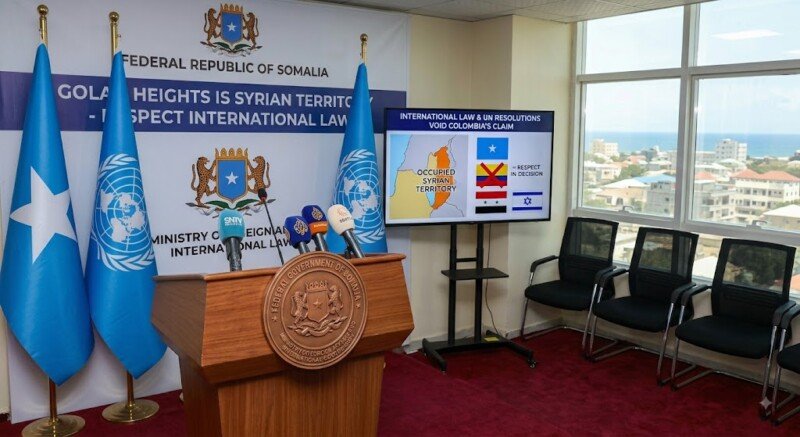
MOGADISHU — The Federal Government of Somalia has strongly condemned Colombia’s decision to recognise Israel’s claim of sovereignty over the Golan Heights, describing the move as a violation of international law and United Nations resolutions.
In a press statement issued on August 12, 2026, the Ministry of Foreign Affairs said that any such recognition is “null and void” and contrary to the UN Charter. The statement emphasised that the Golan Heights is Syrian territory that has been occupied since 1967.
“Any recognition of this kind is null and void and contradicts international law and the United Nations Charter. The Golan Heights is Syrian territory under occupation,” the statement read.
Somalia reaffirmed its support for resolving the dispute between Israel and Syria through dialogue and adherence to relevant UN resolutions, which affirm Syria’s right to the full return of its occupied territories along the pre-1967 borders.
The government called on all states, including Colombia, to respect international law, uphold the sovereignty and territorial integrity of states, and refrain from recognising occupied territories.
Colombia’s Foreign Ministry announced its recognition of Israel’s sovereignty claim over the Golan Heights on August 10, 2026, making it only the second country after the United States to formally recognise the claim. The decision came days after Colombia’s new president, Abelardo de la Espriella, took office.
Somalia has consistently opposed Israeli claims over the Golan Heights, maintaining that the territory is Syrian land under occupation and that any recognition of Israeli sovereignty is illegal.
Somalia’s position on Israel has been marked by deep mistrust, with former officials warning of Israeli infiltration into Somali institutions and political decision-making processes.
Somalia has consistently reaffirmed its unwavering solidarity with the Palestinian people, emphasising the urgent need for a two-state solution and an end to the violence and suffering in the region.
Regional and International Implications
The Golan Heights has been occupied by Israel since the 1967 Six-Day War and was annexed in 1981, a move not recognised by the international community. Colombia’s recognition of Israeli sovereignty represents a significant diplomatic shift, following the United States’ recognition of Israeli sovereignty over the Golan Heights in 2019.
Somalia’s condemnation of Colombia’s decision aligns with the position of the Arab League and the broader international community, which has consistently rejected any unilateral changes to the status of the Golan Heights. The United Nations continues to regard the Golan Heights as Syrian territory.
Somalia has previously condemned Israel’s sovereignty claim on the Golan Heights, describing the Golan Heights as occupied Syrian territory and rejecting any unilateral changes to its status.
Somalia has also firmly rejected Israeli moves undermining its own sovereignty, including the appointment of a diplomatic representative to the breakaway region of Somaliland, which it described as a direct breach of its territorial integrity.
Critical Note
While Somalia’s condemnation of Colombia’s recognition of Israeli sovereignty over the Golan Heights is consistent with its long-standing diplomatic positions, the effectiveness of such statements depends on whether they are backed by concrete diplomatic action. The government’s ability to influence international opinion on this issue is limited by its own domestic challenges and the broader geopolitical dynamics of the region.
Nevertheless, Somalia’s principled stance on the Golan Heights reaffirms its commitment to international law and the sovereignty of states, and its call for dialogue as the appropriate means to resolve territorial disputes is a constructive approach that should be supported by the international community.