MALÉ – Somalia has formally restored direct diplomatic engagement with the Maldives, nearly four decades after the two Indian Ocean nations first established relations, as Somalia’s Ambassador to India, Dr. Abdullahi Mohamed Odowa, presented his credentials as non-resident ambassador to Maldivian President Dr. Mohamed Muizzu.
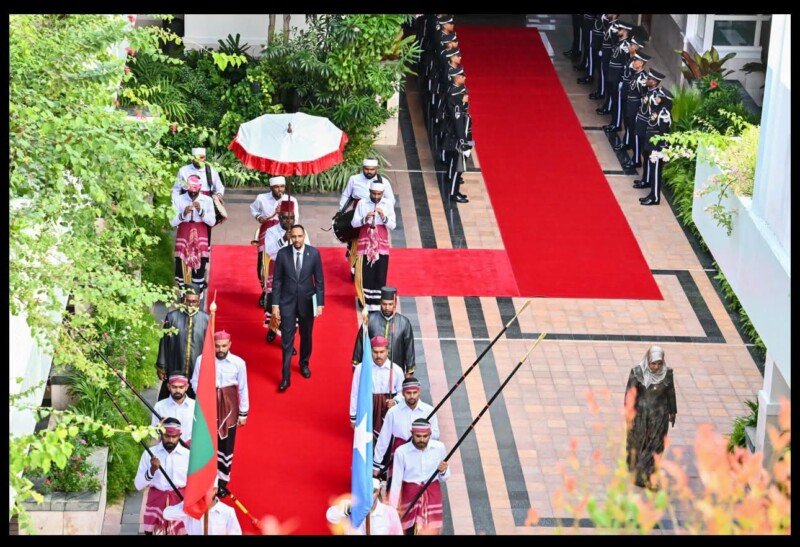
The ceremony, held on July 22 at the President’s Office in Malé, was conducted with full diplomatic protocol, including a traditional ‘Haiykolhu’ cultural procession accompanied by the Maldives National Defence Force Drum and Trumpet Band. Ambassador Odowa, who also serves as Somalia’s non-resident ambassador to Sri Lanka, was accompanied by First Counsellor Ayan Mohamoud Sheikh Hamid of the Somali Embassy in India. Odowa previously met with Sri Lankan officials to strengthen bilateral cooperation, underscoring his active role in expanding Somalia’s diplomatic footprint across South Asia.
A Relationship Restored After Decades of Distance
Diplomatic relations between Somalia and the Maldives were first established on March 10, 1988, but the relationship had little opportunity to develop before Somalia’s state collapse and the civil war that dismantled its diplomatic network. For decades, the two countries, despite their shared faith, their membership in the Organisation of Islamic Cooperation, and their common identity as Indian Ocean maritime nations, dealt with one another only at a distance. The presentation of credentials in Malé restores the direct channel that history withheld.
Following the ceremony, President Muizzu and Ambassador Odowa discussed ways to expand bilateral cooperation in areas of mutual interest and exchanged views on promoting peace and security in the Indian Ocean region. Both sides reaffirmed their commitment to strengthening relations between the two countries. Somalia had earlier extended its congratulations to the Maldives on its 60th independence anniversary, underscoring the warm ties between the two nations.
A Pragmatic Model for Diplomatic Recovery
The appointment reflects the practical architecture through which Somalia is rebuilding its diplomatic reach. Rather than opening costly resident missions in every capital, the government has accredited its ambassadors to neighbouring and regional states on a non-resident basis. The model allows a recovering foreign service to be present in more capitals than it could otherwise afford, and to upgrade its presence as relationships and resources grow.
The restored relationship also carries a natural agenda. Somalia and the Maldives are both maritime nations whose futures are bound to the Indian Ocean, with shared stakes in fisheries, shipping, the blue economy and the security of the sea lanes on which both depend. As Somalia deepens its engagement on maritime security with a widening circle of partners, and as the Maldives navigates its own position in an increasingly contested ocean, the two countries have more to discuss than at any point since their relations began.
Symbolism Over Substance
While the restoration of diplomatic ties is a welcome step, it remains largely symbolic. Somalia’s foreign service is still in the early stages of rebuilding a global presence that a generation of crisis took from it. The non-resident ambassador model, while pragmatic, also reflects the severe resource constraints that continue to limit Somalia’s diplomatic capacity. The appointment adds to a season of visible motion in Somali diplomacy, but each step is modest on its own, and the gap between diplomatic ambition and institutional reality remains wide.
The timing of the restoration also invites scrutiny. Somalia is currently engaged in a broader push to expand its diplomatic footprint, with the Council of Ministers recently approving new ambassadorial appointments and the Foreign Ministry’s training institute opening a programme to prepare the next generation of Somali diplomats. Somalia has been intensifying diplomatic relations with major world economies, including India, as part of this broader push. Yet the government’s failure to ensure parliamentary oversight and public transparency in its international agreements raises questions about whether these diplomatic initiatives will genuinely benefit the Somali people or primarily serve the interests of political elites.
Way Forward
The restoration of direct diplomatic ties between Somalia and the Maldives is a modest but meaningful step in Somalia’s long road to diplomatic recovery. It reflects the government’s pragmatic approach to rebuilding its foreign service and its recognition of the shared interests that bind the two Indian Ocean nations. However, the success of this initiative will depend on whether it translates into tangible cooperation on issues of mutual concern, or whether it remains a symbolic gesture in a broader pattern of diplomatic activity that has yet to deliver concrete results for the Somali people.