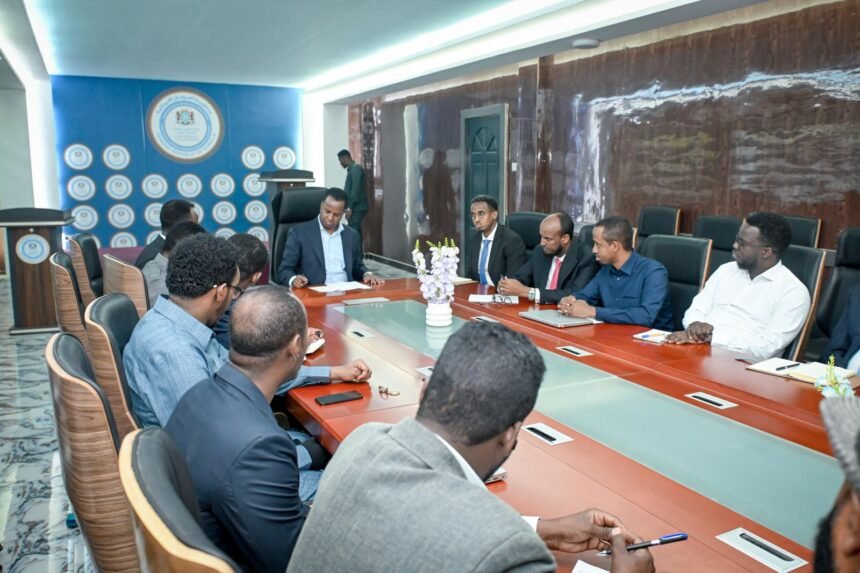
MOGADISHU – The Minister of Foreign Affairs and International Cooperation for the Federal Government of Somalia, Abdisalam Abdi Ali, convened with departmental directors on Sunday to assess the Ministry’s activities and address critical diplomatic matters facing the country.
The closed-door meeting, held at the Ministry’s headquarters in the capital, brought together directors from key departments including political affairs, bilateral relations, international organizations, and consular services. The gathering forms part of the Ministry’s regular internal review process as Somalia continues to navigate a complex regional and international landscape following Israel’s formal recognition of Somaliland in late 2025, a move that has reshaped diplomatic dynamics in the Horn of Africa.
Minister Briefs Directors on Current Diplomatic Efforts
According to an official statement released after the meeting, Minister Abdisalam briefed the directors on ongoing diplomatic efforts across multiple fronts. He provided an overview of Somalia’s engagements with international partners, including the United Nations, the African Union, the Arab League, and the Intergovernmental Authority on Development (IGAD).
The Minister emphasized the need for a unified approach to advancing Somalia’s foreign policy objectives, particularly concerning the country’s territorial integrity and sovereignty. Egypt has been a key ally in this effort, condemning Israel’s appointment of an envoy to Somaliland as a flagrant violation of international law and rallying regional support for Somalia’s position.
Call for Enhanced Coordination Across Departments
Minister Abdisalam offered direction on enhancing coordination between the Ministry’s various departments and promoting Somalia’s foreign policy goals more effectively. He stressed that internal coherence and streamlined communication are essential for presenting a consistent message to Somalia’s international partners.
The Foreign Minister urged directors to strengthen information sharing and align their departmental activities with the Federal Government’s broader diplomatic strategy. He also called for improved responsiveness to emerging issues, noting that the speed of diplomatic engagement can often determine outcomes in fast-moving international disputes. Recent international relations developments covered by FTL Somalia highlight the increasing complexity of Somalia’s diplomatic environment.
Key Diplomatic Challenges on Somalia’s Agenda
The meeting took place against a backdrop of mounting diplomatic pressure on the Federal Government. Somalia continues to face challenges related to the recognition of Somaliland by foreign states, with Israel having formally recognized the breakaway region in late 2025. The African Union and Arab League have condemned the recognition, but Mogadishu remains concerned about potential follow-on moves by other nations.
In response to these challenges, Somalia’s Foreign Minister has actively engaged with the African Union Peace and Security Council to secure continued support for the country’s territorial integrity. The African Union has consistently reaffirmed its respect for Somalia’s sovereignty, unity, and territorial integrity while supporting the operations of the AU Support and Stabilization Mission in Somalia (AUSSOM).
Somalia’s diplomatic corps is also engaged in ongoing discussions with international partners regarding security cooperation, debt relief progress, and the transition of responsibilities from the African Union Transition Mission in Somalia (ATMIS) to Somali security forces.
Ministry’s Focus on Regional Engagement
Regional diplomacy remains a priority for the Federal Government. Minister Abdisalam has previously engaged with counterparts from neighboring countries on issues of mutual concern, including trade cooperation, counterterrorism efforts, and the management of shared water resources.
The Ministry has also been working to strengthen ties with Gulf states and other strategic partners. Somalia has protested the UAE’s decision to invite the Somaliland president to the World Government Summit in Dubai, viewing such invitations as violations of its sovereignty. Recent diplomatic initiatives have sought to balance Somalia’s traditional alliances while opening new channels of cooperation with emerging partners.
International Support for Somalia’s Sovereignty
Despite the challenges posed by Somaliland’s recognition by certain foreign actors, Somalia has continued to receive strong international backing. The United Kingdom has engaged with Somaliland officials on trade and the Berbera Corridor, though it has not followed Israel in extending formal recognition. Meanwhile, the Gulf Cooperation Council has stressed its support for Somalia’s security, stability, sovereignty, and territorial integrity.
Minister Abdisalam’s recent diplomatic engagements have included talks with Saudi counterparts, who reaffirmed the Kingdom’s full support for the sovereignty, unity, and territorial integrity of the Federal Republic of Somalia. Saudi Arabia has consistently rejected any actions that could undermine these principles.
No Public Statement on Specific Outcomes
The Ministry did not release specific details regarding action items or timelines following the directors’ meeting. Officials familiar with the gathering described it as a routine internal coordination exercise rather than a forum for announcing new policy initiatives.
However, the meeting’s timing suggests that the Foreign Ministry is preparing for intensified diplomatic activity in the coming weeks. Somalia is expected to raise its territorial integrity concerns at upcoming sessions of the African Union Peace and Security Council and the United Nations General Assembly.
The Minister’s emphasis on coordination and internal coherence reflects an understanding that Somalia’s diplomatic challenges require a well-organized and responsive foreign ministry. As external actors increase their engagement with Somalia’s regional states and breakaway regions, the effectiveness of Mogadishu’s diplomatic response may depend significantly on the Ministry’s internal functionality.
Recommended Reading On ftlsomalia.com:
- Israel Officially Recognizes Somaliland as Independent Sovereign State
- Egypt Condemns Israel’s Somaliland Envoy Appointment as Legal Breach
- Foreign Minister Speaks at AU PSC on Somalia’s Territorial Integrity
- Somalia Protests UAE’s Decision to Invite Somaliland President
- UK, Somaliland Officials Discuss Trade and Berbera Corridor Opportunities
- CNN: Somaliland Provided Covert Military Position to Israel During Iran War