MOGADISHU – Somalia’s Ministry of Agriculture and Irrigation has officially denied reports circulating on social media that large quantities of bananas are being imported from Kenya, in a statement that directly contradicts earlier reporting on the issue.
In a brief statement issued on Thursday, the ministry dismissed the reports as false and urged the public to rely on official government sources for accurate information regarding agricultural imports. “The Federal Government Ministry of Agriculture and Irrigation denies the reports being circulated by some people claiming that Kenya imports large quantities of bananas to Somalia,” the ministry said.
Contradicting the Narrative
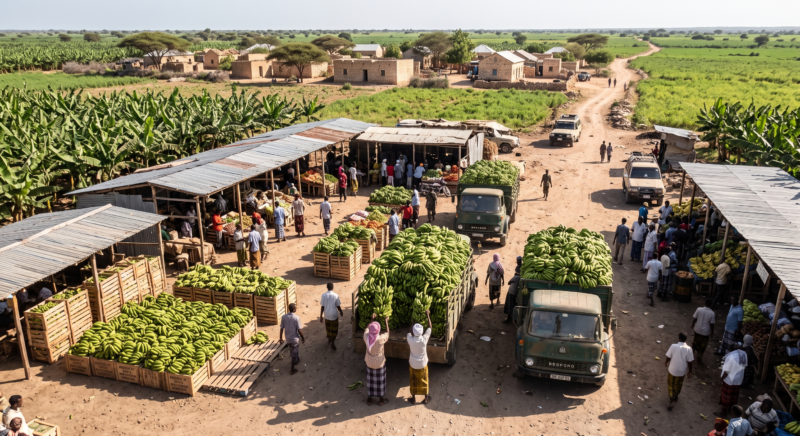
The ministry’s denial comes after widespread social media discussion over reports alleging that bananas from Kenya were being brought into Somalia for commercial sale. An earlier FTL Somalia report claimed that Kenyan bananas were reaching Mogadishu markets by sea without facing the checkpoints, government extortion, or import taxes that continue to suffocate Somali farmers in the country’s historic banana heartlands of Janaale and Buulo-Mareer.
That report cited World Bank COMTRADE data showing that Kenya exported $64,000 worth of bananas to Somalia in 2024, amounting to 1,058 kilograms. It also noted that Somalia imported $2.84 million worth of bananas from Ethiopia and Kenya combined, with Ethiopia dominating the market. However, the ministry’s statement now calls these claims into question.
Somalia’s Banana Sector: A Complex Reality
Somalia is itself a major banana-producing country, with bananas grown in several parts of the country and regularly supplied to markets in Mogadishu and other regions. Janaale in the Lower Shabelle region was previously the centre of a banana production area covering 20,000 hectares. By the early 1990s, Somalia was one of Africa’s main banana producers and exporters.
The earlier report detailed how Somali farmers face costs linked to checkpoints, locally known as isbaaro, as well as payments demanded by Al-Shabaab in production and trading areas. These costs are incorporated into market prices and reduce the competitiveness of locally grown bananas. Somali security forces and AUSSOM have dismantled checkpoints around Janaale, while operations have also targeted tax collection sites in Lower Shabelle.
However, transport and market access constraints remain. The sector also faces production and post-harvest constraints, with one study finding that 48.5% of farm workers in the region had limited knowledge of banana cultivation. Conflict, land disputes, and damage to plantations have also affected production in Lower Shabelle.
Government’s Position and the Path Forward
The ministry’s statement is expected to ease concerns among farmers and traders involved in Somalia’s domestic banana industry while underscoring the government’s call for the public to verify information through official sources. The ministry also appealed to the public to obtain information from its official communication channels and to avoid spreading unverified claims.
The contradiction between the government’s denial and the earlier reporting highlights the broader challenge facing Somalia’s agricultural sector. While the government insists that Kenyan bananas are not flooding the market, farmers continue to struggle with the extortion economy, the lasting effects of conflict, and structural constraints that limit their ability to compete. The gap between official statements and on-the-ground realities remains wide, and until the government addresses the root causes of the sector’s decline, the debate over imports is likely to persist.
Way Forward
The Agriculture Ministry’s denial of Kenyan banana imports represents an attempt to reassure domestic farmers and assert the government’s commitment to protecting local agriculture. However, the underlying challenges facing Somalia’s banana sector, including extortion, conflict, and market access constraints, remain unresolved. As Kenya and Somalia continue discussions on a trade facilitation agreement to address non-tariff barriers, the need for transparent data and accountable governance has never been greater.
Recommended Reading On ftlsomalia.com
- Kenyan Bananas Flood Mogadishu Markets as Somali Farmers Suffocate Under Checkpoint-Isbaaro Extortion
- SNA and AUSSOM Dismantle Al-Shabaab Checkpoint Near Janaale
- A Trade Facilitation Agreement between Somalia and Kenya is in the Offing
- Minister Reports Rise in Somali Farming with Growing Public Awareness
- Somalia Approves Meat Inspection and Protection Law to Boost Food Safety and Exports