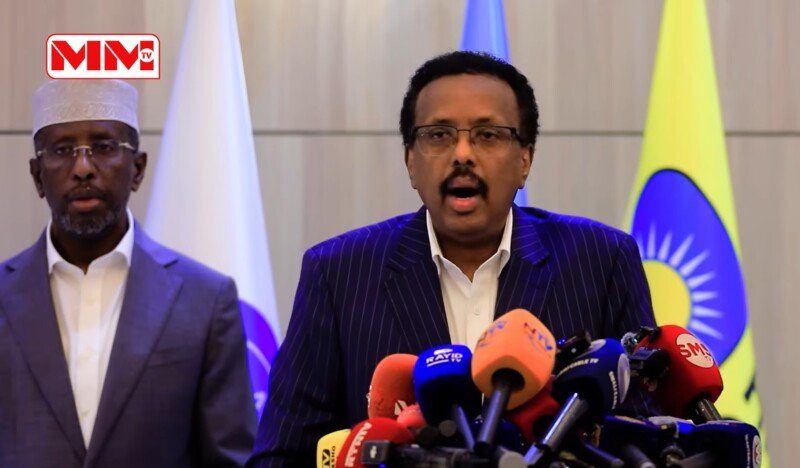
MOGADISHU – Former Presidents Sharif Sheikh Ahmed and Mohamed Abdullahi Farmaajo held a joint press conference in Mogadishu on Sunday, accusing the Federal Government of Somalia of imposing restrictions on opposition leaders and warning that a “stolen election” cannot be accepted.
Speaking to reporters, Sharif Sheikh Ahmed claimed that basic services including electricity, water, and food supplies to the center where he was staying had been cut off. He also alleged that supporters and other visitors were denied entry to the premises.
“They cut off our electricity, they cut off our water, they denied us food, and they prevented people from coming to see us. All of these actions violate the constitution and democratic principles,” Sharif said.
Warning Against Stolen Elections
Sharif also strongly addressed the controversy surrounding the country’s election process. He stated that an election managed or whose results are determined solely by the ruling administration cannot be accepted.
“A stolen election or one arranged by the current regime itself cannot take place. Only a fair and consensual election can lead the country,” he said.
The former president accused the government of using security forces to suppress the opposition and prevent planned demonstrations, which he said were related to political issues and the situation of displaced people. He added that forces meant to defend the country and maintain security are instead being used to put pressure on opposition politicians.
“We are not enemies of the country. We are people who participated in the rebuilding of Somali statehood. Shooting at us or suppressing us is far from ethics and statehood,” Sharif said.
Farmaajo Condemns Attack on Sharif, Invites President to Dialogue
Former President Mohamed Abdullahi Farmaajo, speaking alongside Sharif, strongly criticized the government’s recent actions. He expressed condolences to Sharif for what he described as a “bad and abusive act of humiliation” committed against him after a ceasefire agreement had been reached.
Farmaajo stated that Sharif was fought like an enemy and that the government intended to assassinate him. “Working together, Sharif and I liberated this city from Al-Shabaab, and we liberated Middle Shabelle and Lower Shabelle. The power was handed over peacefully to Hassan Sheikh after the city had been cleared for him,” Farmaajo said.
“Does a president (Sharif) who did all that deserve to have his life put in danger and to be attacked at his home?” he added.
Farmaajo announced that he is hosting a dialogue forum at his home in Mogadishu and extended an invitation to President Hassan Sheikh Mohamud so that a meeting between the president and opposition leaders could take place at his residence.
“If he refuses or does not come, we welcome Somali friends who are eager to intervene in this matter. Let this fragile statehood not crumble by our own hands; whomever God has decreed will become president,” Farmaajo said.
Political Context of the Accusations
The accusations come amid heightened political tensions following recent clashes in Mogadishu between government forces and opposition-aligned militias. Sharif placed responsibility for the recent events on President Hassan Sheikh Mohamud, accusing him of being behind the measures to block opposition activities.
The Federal Government of Somalia extended its mandate for one year under the newly adopted constitution, a move that opposition figures and several federal member states have rejected as lacking national consensus.
International Concern and Mediation Efforts
The political standoff has drawn concern from international partners who have called for dialogue between the government and opposition figures.
International partners including the UN, African Union, EU, IGAD, the United States, and the United Kingdom have urged renewed dialogue between the Somali government and opposition groups. The United States delivered one of its most explicit public statements against the use of force on political protesters in Somalia.
Turkey has also stepped into a mediation role, with a Turkish delegation conducting separate meetings with federal government officials and opposition leaders. Unconfirmed reports suggest that the Head of Turkey’s National Intelligence Organization (MIT) arrived in Mogadishu as part of Ankara’s efforts to broker a ceasefire and facilitate political dialogue.
No Official Government Response
The Federal Government of Somalia has not yet officially responded to the accusations made by the former presidents. Authorities have previously maintained that ongoing security operations in Mogadishu are aimed at maintaining public order and addressing security threats, while opposition figures argue that the actions violate previous understandings intended to reduce tensions between political actors in the capital.
The invitation extended by Farmaajo for a dialogue meeting at his residence presents an opportunity for potential de-escalation. Whether President Mohamud will accept the invitation remains unclear, as does the prospect of meaningful political dialogue to resolve the country’s electoral and constitutional disputes.
Recommended Reading On ftlsomalia.com:
- Opposition Warns Against ‘Red Lines’ on Term Extension and Disputed Elections
- Somalia Government Extends Mandate for One Year Under New Constitution
- International Community Urges Renewed Dialogue Between Somali Government and Opposition Groups
- Somali Minister Accuses Former Leaders of Coup Attempt After Mogadishu Clashes
- Turkey Joins Mediation Efforts as Former President’s Move Away from Marinayo Signals Potential De-escalation