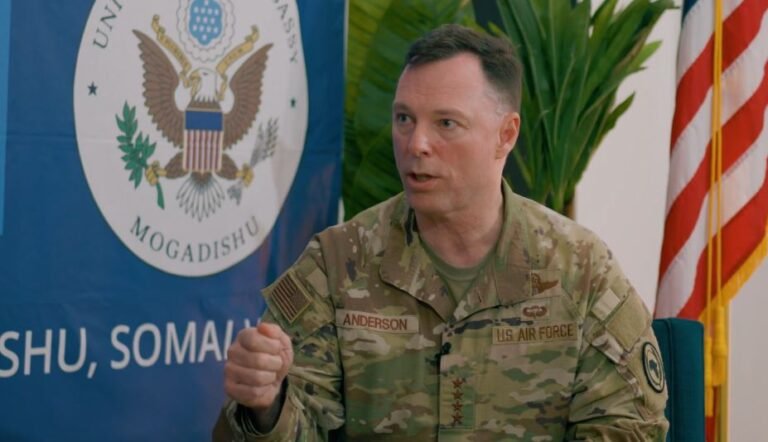
MOGADISHU – The Commander of U.S. Africa Command (AFRICOM), General Dagvin Anderson, has acknowledged that American airstrikes in Somalia have killed civilians in the past, while insisting that the military takes extensive precautions to avoid civilian casualties and investigates credible allegations of harm.
In an interview with local media in Mogadishu, Anderson addressed concerns about the air campaign against Al-Shabaab and the Islamic State’s Somalia affiliate, which has continued at a steady pace through this year. “We take great effort with our intelligence, our targeting, and our understanding to avoid harm to civilians,” Anderson said. “Any credible instance, we will investigate. There have been times when we have made mistakes, and we have provided reparations.”
A Record of Contradiction
The record on the ground is harder to pin down than that assurance suggests. AFRICOM’s own public tally for strikes carried out in 2025 recorded no civilian deaths in any of them, according to a review by the research group New America. Independent monitors have documented a different picture. Airwars, which tracks civilian harm from international military operations, has recorded incidents including a strike or ground operation near Jamaame in southern Somalia last November that reportedly killed at least 21 people, among them children and an elderly man, and a September strike outside Badhan that reportedly killed a local village chief whom AFRICOM described only as an Al-Shabaab weapons dealer without confirming his identity or death. AFRICOM has disputed or left unresolved several such cases, and the command’s quarterly civilian harm reports show a limited number of allegations formally substantiated.
AFRICOM has previously admitted that civilians died during one of its bombings carried out in Somalia on February 23, 2019. The United States military has received allegations from human rights groups of 27 incidents involving civilians in Somalia. It has also been investigating allegations that 90 civilians were either injured or killed during airstrikes. Its statement said, “The February 23, 2019 incident caused two civilian deaths and three injuries, which we regret. Our intended targets were Al-Shabaab militants.”
The Toll of Militant Violence
Anderson did not address specific incidents in the interview, but he pushed back on the broader narrative that American strikes are a leading source of civilian harm in the conflict. He argued that the toll from Al-Shabaab and the Islamic State dwarfs anything caused by U.S. operations. “Where are the civilian casualties coming from here? And how many civilian casualties has Al-Shabaab created or ISIS? It’s thousands,” he said, adding that the group’s damage should also be measured in the development and stability it has prevented, not only in the people it has killed.
He also cautioned that Al-Shabaab has an incentive to exaggerate or fabricate claims of civilian harm as part of its propaganda, saying the group does so “almost every single time,” and that AFRICOM tries to establish the credibility of a claim before opening a formal review.
The Challenge of Accountability
Civilian casualty allegations have long been among the most sensitive aspects of the American campaign in Somalia. Rights groups and local communities have periodically questioned whether investigations into strikes are transparent enough and whether victims and their families receive meaningful compensation when harm is confirmed. Anderson’s acknowledgment that mistakes have happened, even in general terms, marked a notable moment in a conflict where civilian protection remains a central test of credibility for every side involved, the Somali government and Al-Shabaab included.
In one of the most serious incidents, more than 30 civilians lost their lives and dozens were injured during a Somali special forces operation near Afgooye, with residents reporting that the raid was executed by Danab commandos who received training from AFRICOM. Villagers stated that the deadly raid in Jambaluul was carried out while families were asleep, and there was no fighting in the area prior to the assault. Medical staff at the main hospital in Afgoye town confirmed treating over 100 wounded civilians.
Concerns over rising civilian casualties have intensified following a separate airstrike in the Calmiskaad mountains in May 2026, which killed a pregnant woman and her three daughters. In that incident, Somalia’s deputy ambassador to Tanzania called for accountability and warned of possible legal action if regional authorities failed to investigate. In another case, a Somali elder and respected mediator, Sultan Said Abdisalam, expressed deep sorrow and anger following the death of his close friend in a U.S. drone strike in Lower Shabelle. The elder insisted that the strike had targeted the wrong man, stating: “They say they fight terrorists. But they killed the man fighting to stop terror.”
Way Forward
Anderson said the United States would continue to examine credible reports of civilian harm as the air campaign continues, underscoring that for communities living near the front lines, the distinction between military necessity and civilian safety is not an abstract one. It is measured in whether operations against militants can be carried out without adding to the losses of families who have already lived through decades of war, displacement and, in recent years, renewed fighting as Al-Shabaab has regrouped in areas once cleared by Somali and American backed forces.
The United States has significantly ramped up its aerial campaign in Somalia, with nearly 50 airstrikes conducted in the first quarter of 2026 alone, a massive increase in military actions directed against extremist organisations operating in the Horn of Africa. Claims of civilian casualties can complicate counterterrorism partnerships and weaken public support for security operations, particularly in areas where military efforts depend on cooperation with local communities. The question remains whether the United States can maintain its campaign against militants while earning the trust of the Somali people it claims to protect.
Recommended Reading On ftlsomalia.com
- “Civilians Were Killed in Somalia,” says the United States
- Guardian Probe Alleges U.S. Drone Strike Killed Civilians
- Raid by U.S.-Trained Unit in Somalia Leaves Civilians Dead
- Airstrike Kills Woman, Daughters in Northeastern Somalia Amid Rising Civilian Deaths
- Somali Elder Mourns Friend Killed in U.S. Drone Strike, Demands Accountability
- US Has Undertaken Over 100 Airstrikes in Somalia Under President Trump