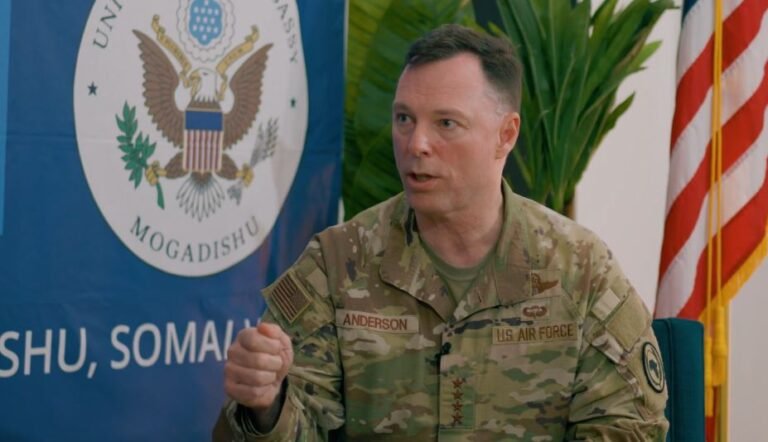
WASHINGTON – The Commander of U.S. Africa Command (AFRICOM), General Dagvin Anderson, has categorically stated that the United States has no plans to establish a military base in Somaliland, dismissing widespread speculation that has fueled tensions in the Horn of Africa amid a flurry of diplomatic visits to Hargeisa and Berbera.
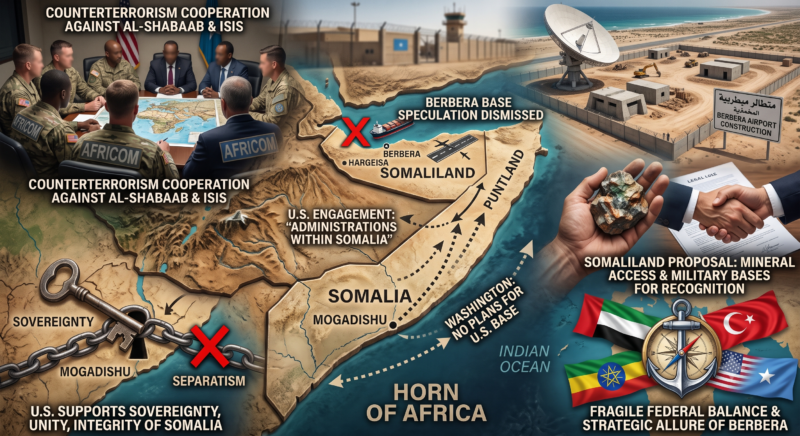
In his first trip to the region since assuming command, General Anderson’s visit to Somaliland and Puntland, where he labeled them “administrations within Somalia,” was aimed at bolstering security collaboration against Al-Shabaab and ISIS, not at laying the groundwork for a permanent U.S. military foothold. He reaffirmed Washington’s longstanding policy of supporting the sovereignty, unity, and territorial integrity of the Federal Republic of Somalia.
A Security-First Approach
The general’s visit was part of a broader U.S. strategy to intensify counterterrorism efforts across the continent. “The main purpose of my visit is our common threats. I know this region well, understand the challenges, and we aim to empower African partners to tackle them collaboratively,” Anderson said.
By engaging with Puntland and Somaliland as “administrations within Somalia,” AFRICOM is employing a subtle tactic that allows for direct military-to-military dialogue outside formal State Department channels. This “security-first” method enables the U.S. to partner with capable local entities while formally acknowledging Mogadishu’s sovereignty.
The U.S. military has reaffirmed its commitment to eliminating ISIS and Al-Shabaab, and this visit was a continuation of that strategy.
The Berbera Base Controversy
The speculation over a U.S. base in Berbera has been a persistent source of tension. Somaliland has long proposed offering the U.S. exclusive access to its mineral resources and military installations in exchange for recognition. Meanwhile, reports have emerged of the UAE secretly building a military facility at Berbera Airport, purportedly intended to serve the interests of the UAE, the U.S., and Israel. Satellite imagery has revealed extensive construction, including concealed bunkers and air defence systems.
However, General Anderson’s statement appears to draw a clear line under these rumors, reiterating that the U.S. is not pursuing a new base. This stance aligns with Washington’s consistent policy of supporting Somalia’s territorial integrity, a position it has reaffirmed despite growing pressure from some U.S. lawmakers to recognize Somaliland.
A Fragile Federal Balance
While the U.S. engages directly with regional administrations to advance security goals, this approach risks straining the fragile federal system. Critics argue that such direct engagement undermines the authority of the Federal Government of Somalia in Mogadishu and could exacerbate center-periphery conflicts. The U.S. has previously engaged with Puntland and Somaliland as “administrations within Somalia,” a formulation that allows military-to-military engagement outside formal State Department channels.
Way Forward
General Anderson’s unequivocal denial of a U.S. military base in Somaliland is a significant clarification. It reaffirms Washington’s commitment to Somalia’s unity while maintaining a pragmatic, security-focused engagement with regional administrations. However, the strategic allure of Berbera, coupled with the competing interests of regional actors like the UAE, Turkey, and Ethiopia, ensures that the question of foreign military presence in the Horn of Africa will remain a critical issue for the foreseeable future. The U.S. must carefully navigate these dynamics to ensure that its counterterrorism objectives do not inadvertently undermine the very stability it seeks to protect.
Recommended Reading On ftlsomalia.com
- US Military Reaffirms Commitment to Eliminate ISIS and Al-Shabaab
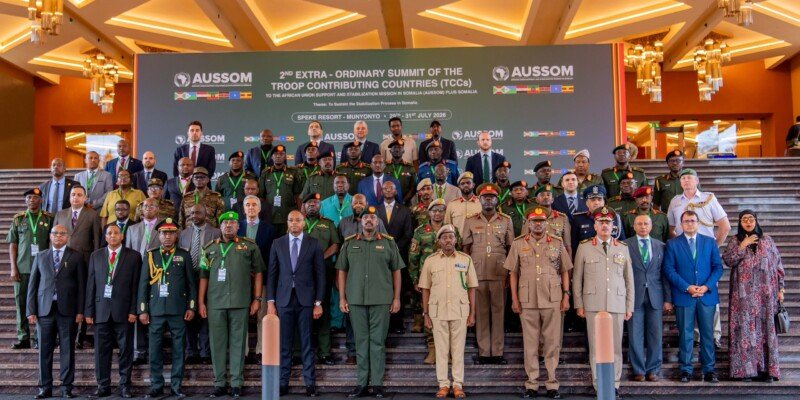
- As AUSSOM Teeters on the Brink, US Delegation Visits Regional Administrations
- AFRICOM Commander Holds Security Talks with Ethiopia, Puntland, Somaliland
- US Reaffirms Support for Somali Forces as Army Chief and AFRICOM General Hold Talks
- Somaliland Proposes Exclusive Mineral Access, Military Bases to US for Recognition
- Le Monde Reports UAE Building Secret Military Base in Berbera for U.S. and Israel